
- Topics 1567
- Industrial 59
- Troubleshooting Guides 32
- Restaurant Management 145
- Bar Management 69
- Catering Tips 43
- Bakery Management 44
- Food Trucks & Concessions 36
- Advertising & Marketing 41
- Eco-Friendly Tips 13
- Facility Layout & Design 47
- Coffee Shop Tips 32
- Installation & Maintenance 63
- Janitorial & Pest Control 34
- Safety & Sanitation 122
- Startup Tips 110
- Menu Design 13
- Kitchen & Cooking Tips 108
- Hospitality Management 25
- Pizza & Sandwich Shop Tips 20
- Smallwares 42
- Food Prep 102
- Tabletop Items 21
- Disposables 28
- Calculators & Tools 7
- Consumables 77
- Warewashing & Laundry 22
- Cooking Equipment 107
- Food Storage & Refrigeration 57
- Beverage Equipment 42
- Office Supplies 6

Commercial meat slicers are essential prep machines for operations that need to slice meats, cheeses, and vegetables quickly and consistently. The right slicer helps maintain uniform portions, speeds up repetitive prep, and supports smoother production. Because these units come in manual and automatic styles with different blade sizes and usage ratings, it can be difficult to narrow down the best fit for your operation. To make that decision easier, we've rounded up the best commercial meat slicers for a range of output levels, kitchen setups, and budgets.
Shop All Commercial Meat Slicers
Check out our top choices for the best commercial meat slicers:
- Best Overall Meat Slicer: Avantco SL713MAN 13" Medium-Duty Manual Gravity Feed Meat Slicer
- Best Mid-Tier Meat Slicer: Globe G12 12" Manual Gravity Feed Slicer - 1/2 hp
- Best Premium Meat Slicer: Hobart HS7-1 13" Heavy-Duty Automatic Slicer with Removable Knife - 1/2 hp
- Best Automatic Meat Slicer: Avantco SL612A 12" Medium-Duty Automatic Meat Slicer with Manual Use Option - 1/2 hp
- Best Budget Meat Slicer: Avantco SL310 10" Manual Gravity Feed Meat Slicer - 1/4 hp
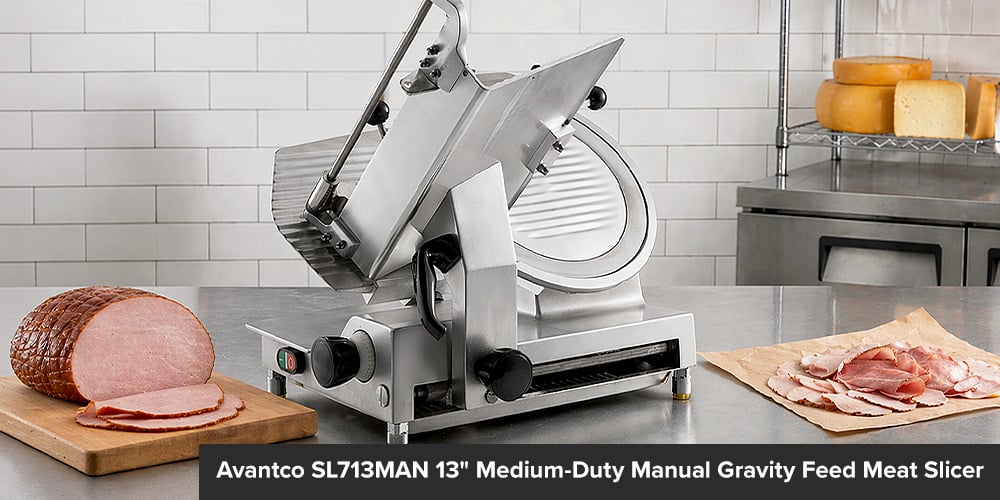
With a 13" stainless steel blade, 3/4 hp motor, and manual gravity-feed design, the Avantco SL713MAN is a great choice for locations that need clean, consistent slicing without jumping to the cost of a premium automatic unit. Its adjustable thickness range from 1/16" to 1/2", 11" x 11" product tray, and capacity for items up to 11" wide by 8" high make it well-suited for everyday slicing of deli meats and cheeses. Built for medium-duty use, this slicer is rated for 3 to 4 hours of daily operation and includes practical commercial features like a built-in sharpener, non-slip rubber feet, and a sturdy aluminum base. It provides strong value and solid slicing performance for light- to mid-volume kitchens, though its large size may mean cleaning and handling take more effort.
Shop the Avantco SL713MAN 13" Medium-Duty Manual Gravity Feed Meat Slicer - 3/4 hp | $1,319.00
Read customer reviews for the Avantco SL713MAN 13" medium-duty manual gravity feed meat slicer.
- Adjustable slice thickness from 1/16" to 1/2" for portion control
- 11" x 11" tray handles products up to 11" wide by 8" high
- Built-in sharpener, aluminum base, and rubber feet support safer day-to-day operation
- Users report cleaning around the blade guard can be tedious
- Users report the unit is heavy to move and maneuver
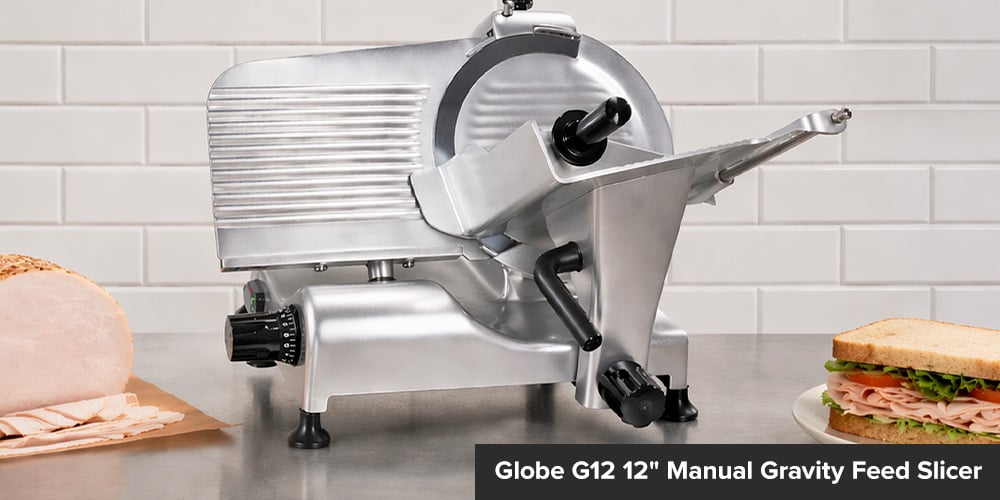
With a belt-driven 1/2 hp motor, 12" blade, and large 35-degree angled carriage, the Globe G12 is a strong medium-duty option for operations that need reliable daily slicing and can't afford larger, premium models. It is built for moderate output, with a workload aimed at about 4 hours of meat slicing and 2 hours of cheese slicing per day. Details like the removable sharpener, knife ring guard, and roomy carriage help it deliver consistent slices while keeping routine maintenance manageable. This equipment gives operators a true mid-tier commercial slicer that can handle both meats and light cheese work while maintaining a smaller footprint and simpler manual operation.
Shop the Globe G12 12" Manual Gravity Feed Slicer - 1/2 hp | $1,885.00
Read customer reviews for the Globe G12 12" manual gravity feed slicer - 1/2 hp.
- Large 35-degree food carriage accommodates sizeable products and helps keep cuts steady and consistent
- Thickness adjustment dial provides 15 settings
- Removable sharpener and easy-to-remove knife cover make blade upkeep and cleaning straightforward
- Users report the belt may need occasional tightening over time
- Users report it is not the best fit for operations that plan to slice a lot of cheese
- Manual operation and periodic lubrication make it less ideal for very high-volume production
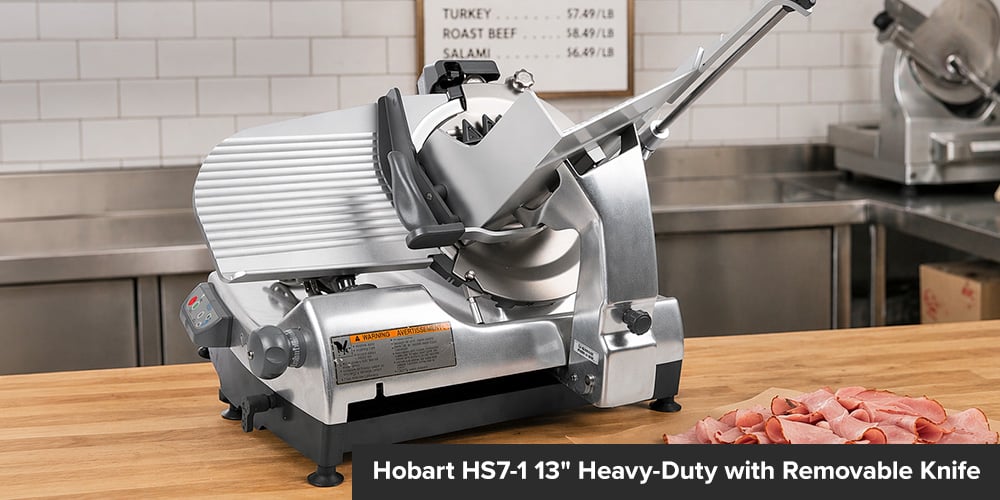
Built for continuous slicing, the Hobart HS7-1 is a premium choice for businesses that need speed, consistency, and stronger safety controls than a standard manual slicer. This slicer's premium durability helps support deli counters and grocery slicer programs that require slicing for long stretches every day. Its 13" removable CleanCut knife, four-speed automatic carriage with three stroke lengths, and 1" maximum slice thickness give operators the flexibility to handle everything from shaved meats to thicker cuts. What separates it from lower-tier models is the combination of automatic operation and zero knife exposure during cleaning and sharpening.
Shop the Hobart HS7-1 13" Heavy-Duty Automatic Slicer with Removable Knife - 1/2 hp | $12,024.60
Read customer reviews for the Hobart HS7-1 13" heavy-duty automatic slicer.
- Four automatic carriage speeds and three stroke lengths
- Extra safety features to protect in busy environments
- Easy end-of-day sanitation
- Large footprint that is difficult to relocate
- Only designed for high-volume operations
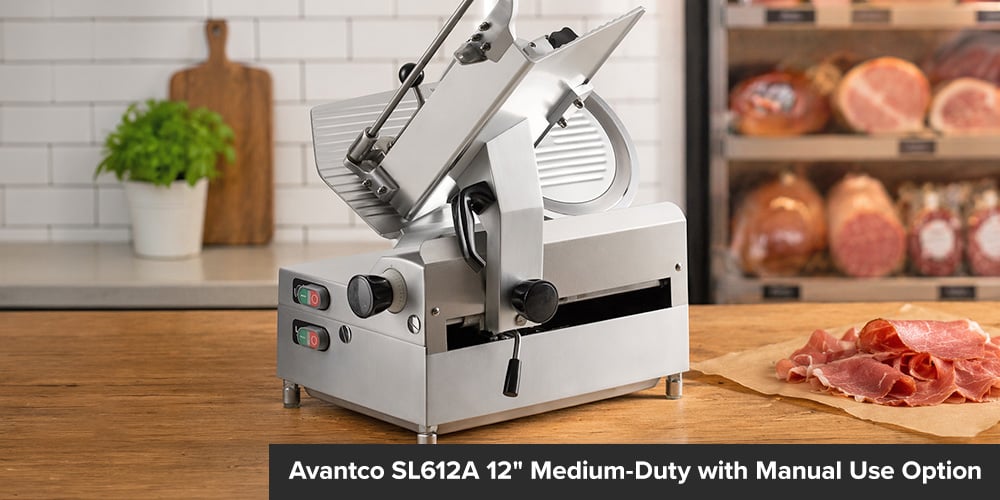
Sporting automatic operation, a manual-use option, and a 1/2 hp motor, the Avantco SL612A stands out as an effective electric meat slicer for establishments that want to speed up prep without giving up control. Its 12" stainless steel blade, 32-slice-per-minute automatic mode, and large 15 1/2" x 10 1/2" carriage make it well-suited for medium-duty slicing of deli meats, hams, salami, and occasional cheese. Operators can use automatic mode for repetitive slicing runs, then switch to manual mode for more hands-on control with different products or slice counts. For kitchens trying to balance labor savings, output, and cost, that combination makes it a practical electric slicer for everyday prep.
Shop the Avantco SL612A 12" Medium-Duty Automatic Meat Slicer with Manual Use Option | $2,239.00
Read customer reviews for the Avantco SL612A 12" medium-duty automatic meat slicer with manual use option.
- Manual-use option adds flexibility
- Large 15 1/2" x 10 1/2" carriage and adjustable horizontal clamps help secure larger products
- Automatic mode produces up to 32 slices per minute, helping staff move through repetitive prep faster
- Components require periodic lubrication
- Users report some difficulty taking unit apart to clean
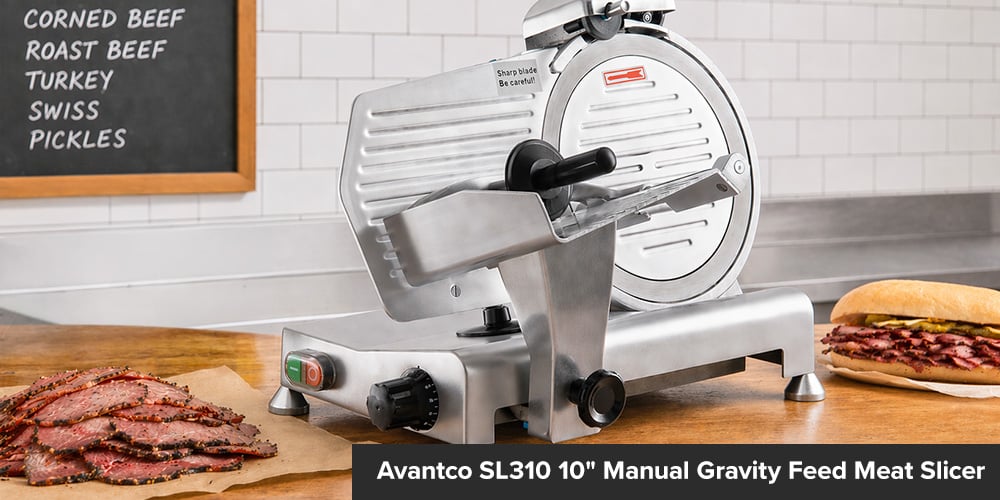
For smaller operations that only need a slicer for short prep runs, the Avantco SL310 keeps things simple. Its 10" blade, manual gravity-feed design, and compact body make it a practical option for establishments where counter space and budget are both limited. Even as an entry-level unit, it still gives operators useful commercial features like adjustable slice thickness, a built-in sharpener, and a removable carriage that makes cleanup easier. If your goal is to bring slicing in-house for sandwich meats, vegetables, and other lighter tasks without committing to a larger machine, this model offers a straightforward, cost-conscious way to do it.
Shop the Avantco SL310 10" Manual Gravity Feed Meat Slicer - 1/4 hp | $429.99
Read customer reviews for the Avantco SL310 10" manual gravity feed meat slicer.
- Good fit for lighter prep schedules
- Easy to fit into smaller kitchens
- Built-in sharpener
- Cannot slice cheese
- Users report that deep cleaning can take more time and effort than expected
How We Chose These Commercial Meat Slicers
The right meat slicer depends on more than price alone. When selecting which units to feature, we focused on the details that have the biggest impact on day-to-day prep: slicer usage rating, operation type, and blade size. Those factors help determine how long a slicer can run, what products it can handle, how much labor it can save, and whether it fits the pace of your kitchen.
Slicer Usage
Slicer usage was one of the first things we looked at because it tells you how much work a machine is built to handle before performance, wear, or cleanup demands become a problem. In this category, mid-tier models are positioned for more frequent use than entry-level slicers, while premium models are designed for heavier, constant production.
- Medium-Duty Slicers: Mid-tier slicers use larger blades, more horsepower, and more safety features than entry-level units, and they are mainly designed for about 2 to 4 hours of deli meat or vegetable slicing per day, with some models able to handle occasional cheese. This makes them a practical fit for sandwich shops, pizzerias, smaller delis, and markets that need steady output without stepping up to a full premium machine.
- Premium Slicers: Premium slicers are built for high-output locations that need 4 or more hours of daily slicing, and they typically add more safety and convenience features while handling both meats and cheeses more comfortably. For commissaries, grocery deli departments, and other operations with long prep runs, that heavier-duty build can justify the higher upfront cost.
Operation Type
We also weighed operation type heavily because it changes how a slicer fits into the workflow. Some kitchens need hands-on control for shorter slicing runs, while others benefit more from a machine that can keep moving through repetitive prep with less operator effort.
- Automatic Slicers: Some units produce 32 slices per minute in automatic mode, adding multiple carriage speeds and stroke lengths for more continuous production. Automatic models are a strong choice when you are slicing the same product in longer batches and want to reduce repetitive labor.
- Manual Slicers: Manual slicers give staff direct control over carriage movement, which is useful for smaller batch prep, made-to-order slicing, or operations that work with different products throughout the day.
Blade Size
Blade size was another major factor because it affects the size of product the slicer can handle and often signals the machine's intended workload. In general, larger blades give operators more flexibility when slicing wider products and keeping up with heavier prep volume.
- 10" Blades: A 10" blade is usually best for lighter-duty slicing and smaller kitchens with limited counter space. These slicers are often a practical fit for occasional sandwich prep, small delis, cafés, and other operations that do not need to process large products or run the machine for long stretches.
- 12" Blades: A 12" blade works well as a middle-ground option for kitchens that need more capacity without stepping into a larger premium machine. This size is common in medium-duty slicers because it can handle a broader range of deli meats, cheeses, and vegetables while still fitting comfortably in many prep areas.
- 13" Blades and Up: Larger blades are better suited for higher-volume operations that need to process bigger products and maintain steady output during long prep runs. They are often found on premium slicers built for deli counters, commissaries, grocery operations, and other environments where speed, capacity, and consistency matter most.
Ease of Cleaning
These machines come into direct contact with ready-to-eat meats, cheeses, and other prep items, which means food residue, grease, and moisture can build up quickly around the blade, carriage, gauge plate, and other contact points. If a slicer is difficult to clean thoroughly, that can create food safety risks and slow down sanitation routines.
Cleaning also has a direct impact on labor. Even a few extra minutes spent disassembling a slicer, scrubbing around hard-to-reach areas, or reassembling components adds up over time. For operations that slice product throughout the day, an accessible design can help reduce downtime between tasks, streamline end-of-day shutdown procedures, and make routine sanitation easier to manage consistently.
A well-matched meat slicer helps control portions, reduce back-of-house prep time, and keep sliced meats and cheeses looking clean and uniform. From lower-volume kitchens to busy deli programs, the right unit can make everyday production more manageable while supporting the pace and standards your operation depends on. Taking the time to choose a slicer that aligns with your output, product mix, and available space can lead to better performance now and fewer compromises later.
Related Resources

October 2026 WebstaurantStore Coupon Code
Fall flavors are in full swing, and the deals at WebstaurantStore are just as irresistible! Stock up on everything your kitchen needs for a busy stretch of autumn, from disposables and pantry staples to equipment that keeps service moving. Browse our featured sale items below, and use code SPICE26 at checkout to save up to 20% on your purchase. Hot drinks, cozy desserts, and warm soups take center stage this time of year, so there's plenty here to fuel your seasonal menu. Sign up for our emails to get exclusive deals and coupon codes delivered straight to your inbox! Looking to save even more? Check out the new Webstaurant Rewards® Visa Business Card ! Sign up for a new card today and start earning rewards on every WebstaurantStore purchase
Best Commercial Vegetable Slicer Reviews
In a bustling commercial kitchen, chefs constantly cut, peel, and slice vegetables to create delicious dishes for their customers. To meet the demands of a fast-paced kitchen environment, having high-performance tools is essential. With the wide array of vegetables that need to be prepped, there is a need for diverse styles of vegetable slicers available in the market. To help you navigate through the myriad of options available, we have curated a list of the best commercial vegetable slicers based on thorough industry research, valuable customer feedback, and insights from our industry experts. Shop All Fruit and Vegetable Cutting Tools Check out our top choices for the best commercial convection ovens: Best Commercial Mandoline Slicer: OX
How to Use a Meat Slicer
Meat slicers , also called deli slicers, are common appliances found in butcher shops, grocery stores, and sandwich shops. They create uniform slices of meat, cheese, vegetables, and other deli products with speed and precision, allowing you to quickly prepare ingredients and fulfill orders. While they may seem simple to operate, it's essential to make sure you and your staff know how to use a meat slicer correctly. By doing so, you can ensure high-quality slices and avoid the risk of serious workplace injury . Shop All Meat Slicers Types of Meat Slice Thicknesses When using a meat slicer, you must know how to achieve the right meat slice thickness. Thickness plays a significant role in the texture of your slices, and each customer will hav
Join Our Mailing List
Receive coupon codes and more right to your inbox.