
- Topics 1570
- Industrial 60
- Troubleshooting Guides 32
- Restaurant Management 145
- Bar Management 69
- Catering Tips 43
- Bakery Management 44
- Food Trucks & Concessions 36
- Advertising & Marketing 41
- Eco-Friendly Tips 13
- Facility Layout & Design 47
- Coffee Shop Tips 32
- Installation & Maintenance 63
- Janitorial & Pest Control 34
- Safety & Sanitation 122
- Startup Tips 110
- Menu Design 13
- Kitchen & Cooking Tips 108
- Hospitality Management 25
- Pizza & Sandwich Shop Tips 21
- Smallwares 42
- Food Prep 103
- Tabletop Items 21
- Disposables 28
- Calculators & Tools 7
- Consumables 77
- Warewashing & Laundry 22
- Cooking Equipment 107
- Food Storage & Refrigeration 57
- Beverage Equipment 42
- Office Supplies 6

Commercial panini grills are countertop cooking appliances that toast, press, and heat sandwiches, wraps, and other menu items with speed and consistency. Common in cafes, delis, concession stands, diners, and quick-service kitchens, they help operators produce crisp exteriors, warm interiors, and appealing grill marks in a compact footprint. Because models vary in plate style, cooking surface size, and output, choosing the right unit depends on your menu, volume, and available space. To make that decision easier, we've conducted thorough industry research, gathered customer feedback, and consulted with our foodservice experts to compile a list of the highest-quality commercial panini grills..
Shop All Commercial Panini Grills
Check out our top choices for the best commercial panini grills:
- Best Overall Panini Grill: Waring WDG250 Grooved Top & Smooth Bottom Panini Sandwich Grill
- Best Smooth Panini Grill: Waring WFG275T Tostato Supremo Smooth Top & Bottom Panini Sandwich Grill with Timer
- Best Dual Panini Grill: Waring WFG300 Tostato Ottimo Smooth Top & Bottom Dual Panini Sandwich Grill
- Best Digital Panini Grill: Proluxe CSD1515E Vantage CS Heavy-Duty Clamshell Sandwich Grill
- Best Budget Panini Grill: Avantco PG200GST Commercial Panini Sandwich Grill
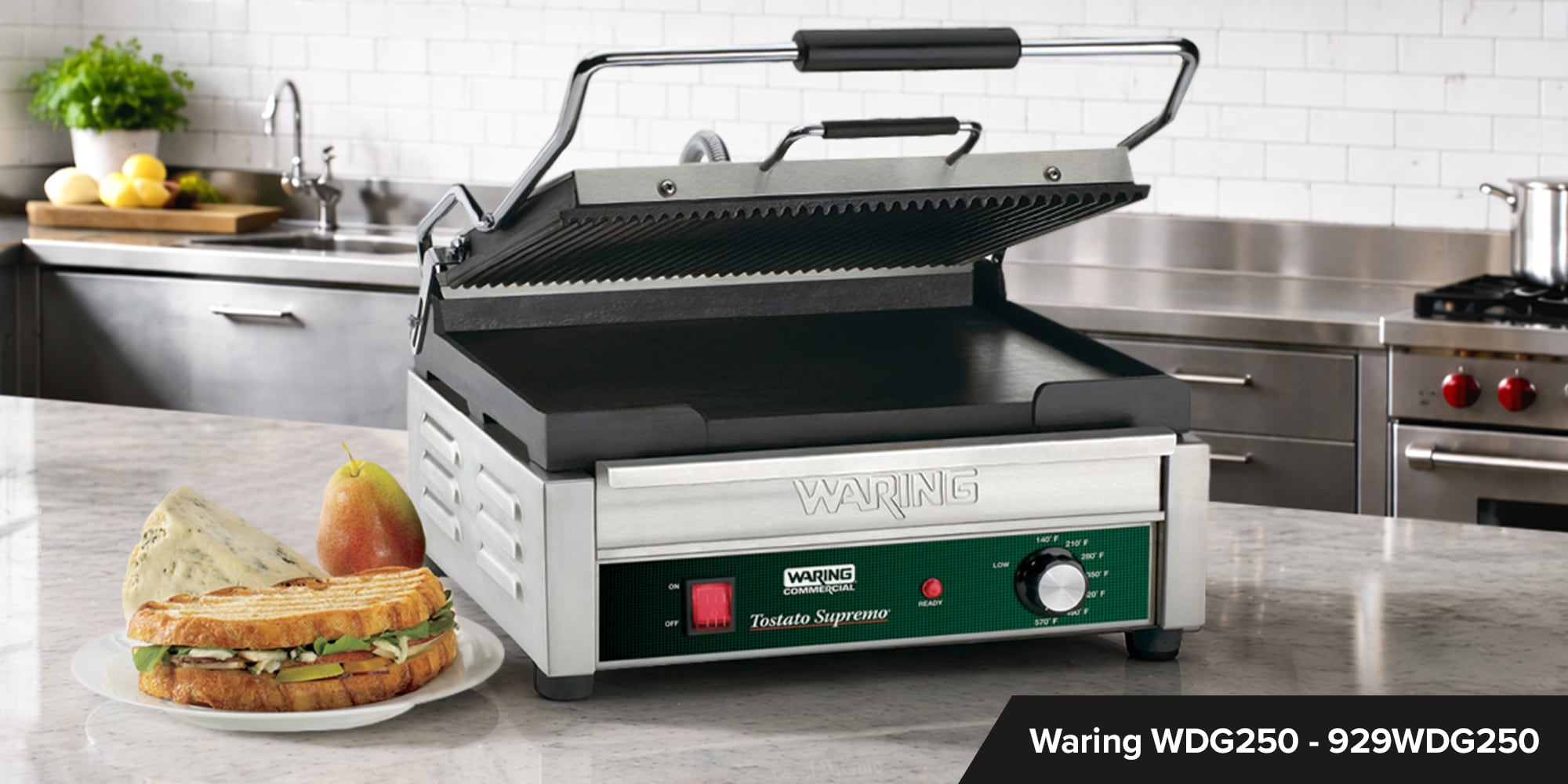
For cafes, delis, concession counters, and lunch-focused kitchens that need one versatile countertop press, the Waring WDG250 is a strong best-overall choice. Its grooved top plate adds defined grill marks while the smooth bottom plate maintains even contact for consistent browning. Its 14 1/2" x 11" cast iron cooking surface, auto-balancing top plate, and removable drip tray make it a practical fit for paninis, wraps, chicken, vegetables, and other pressed menu items. Since it runs on 120V power and is rated for medium-duty use, it works well for operations that want solid output without stepping up to a larger, higher-voltage unit.
Shop the Waring WDG250 Grooved Top & Smooth Bottom Panini Sandwich Grill | $839.00
Read customer reviews for the Waring WDG250 grooved top and smooth bottom panini sandwich grill.
- Provides enough room for multiple sandwiches in a compact countertop footprint
- Removable drip tray and included heavy-duty grill brush help with day-to-day cleanup
- Adjustable thermostat, on/off switch, and ready indicator light keep operation straightforward
- Gives even pressing across different sandwich builds
- Heat-up time can be slower than expected in some applications
- Grooved upper plate can trap residue and require more effort to clean thoroughly
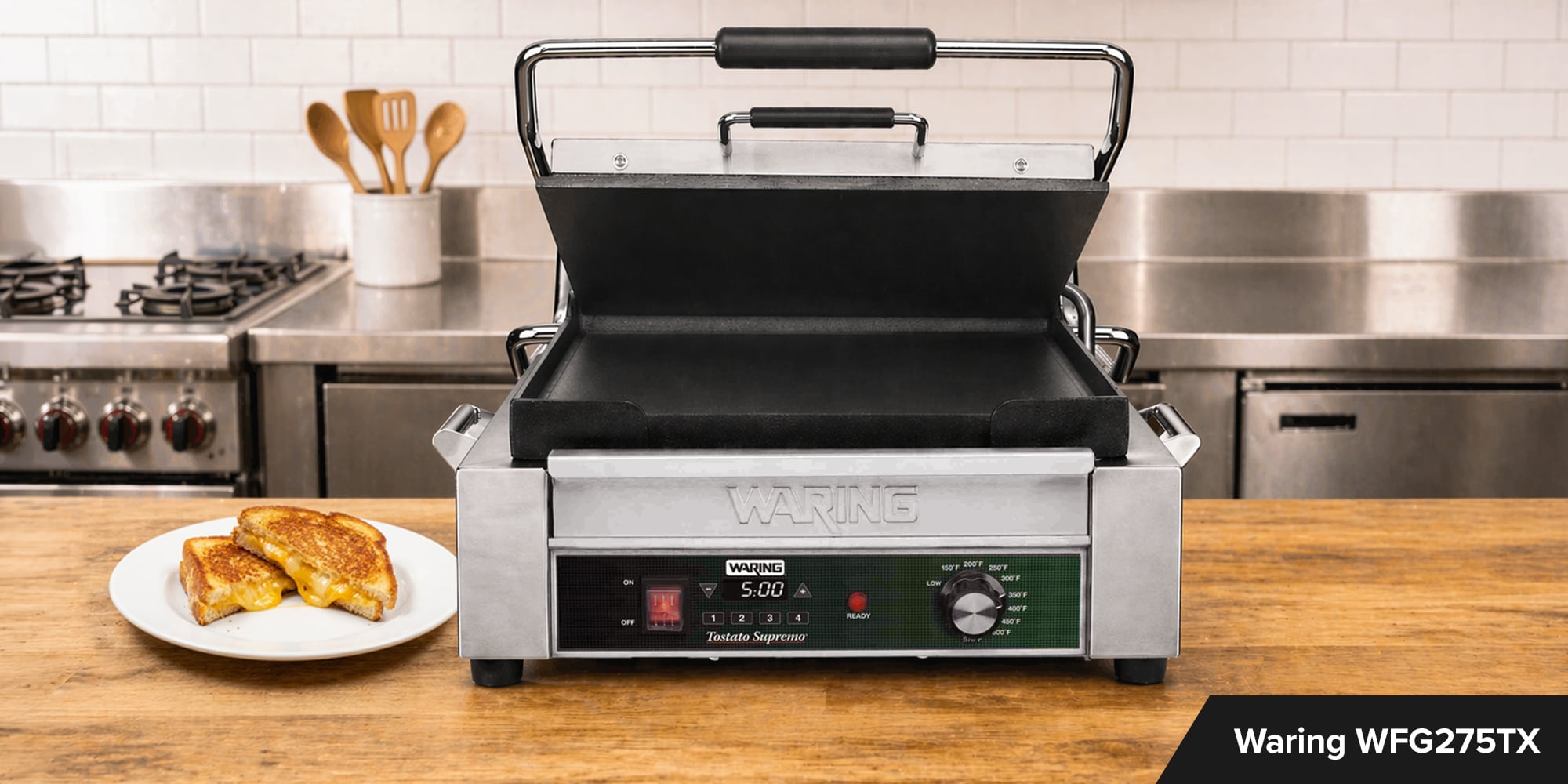
With smooth cast iron plates on both the top and bottom, the Waring WFG275TX is built to give sandwiches full surface contact for even browning and a uniform press, which is why it stands out as a strong pick for sandwich-focused menus. Its 14" x 14" cooking area gives enough space to handle larger breads, quesadillas, and multi-portion sandwich production. In addition, the built-in timer and auto-balancing top plate help operators keep results consistent across different builds.
Waring WFG275TX Tostato Supremo Smooth Top & Bottom Panini Sandwich Grill with Timer | $1,126.00
Read customer reviews for the Waring WFG275TX Tostato Supremo smooth top & bottom panini sandwich grill.
Runner Up: Avantco PG400ST Commercial Dual Panini Sandwich Grill with Timer and Smooth Plates
- Smooth plates provide even pressing and consistent browning
- Offers more working room than smaller sandwich presses
- Built-in timer reduces guesswork and supports more repeatable cook times during busy service
- Straightforward day-to-day use and cleaning
- Smooth plates do not create the pronounced grill marks
- May not offer enough throughput for very high-volume sandwich programs that need dual-press capacity
- Better suited to a fixed prep line than setups that need frequent moving or storage
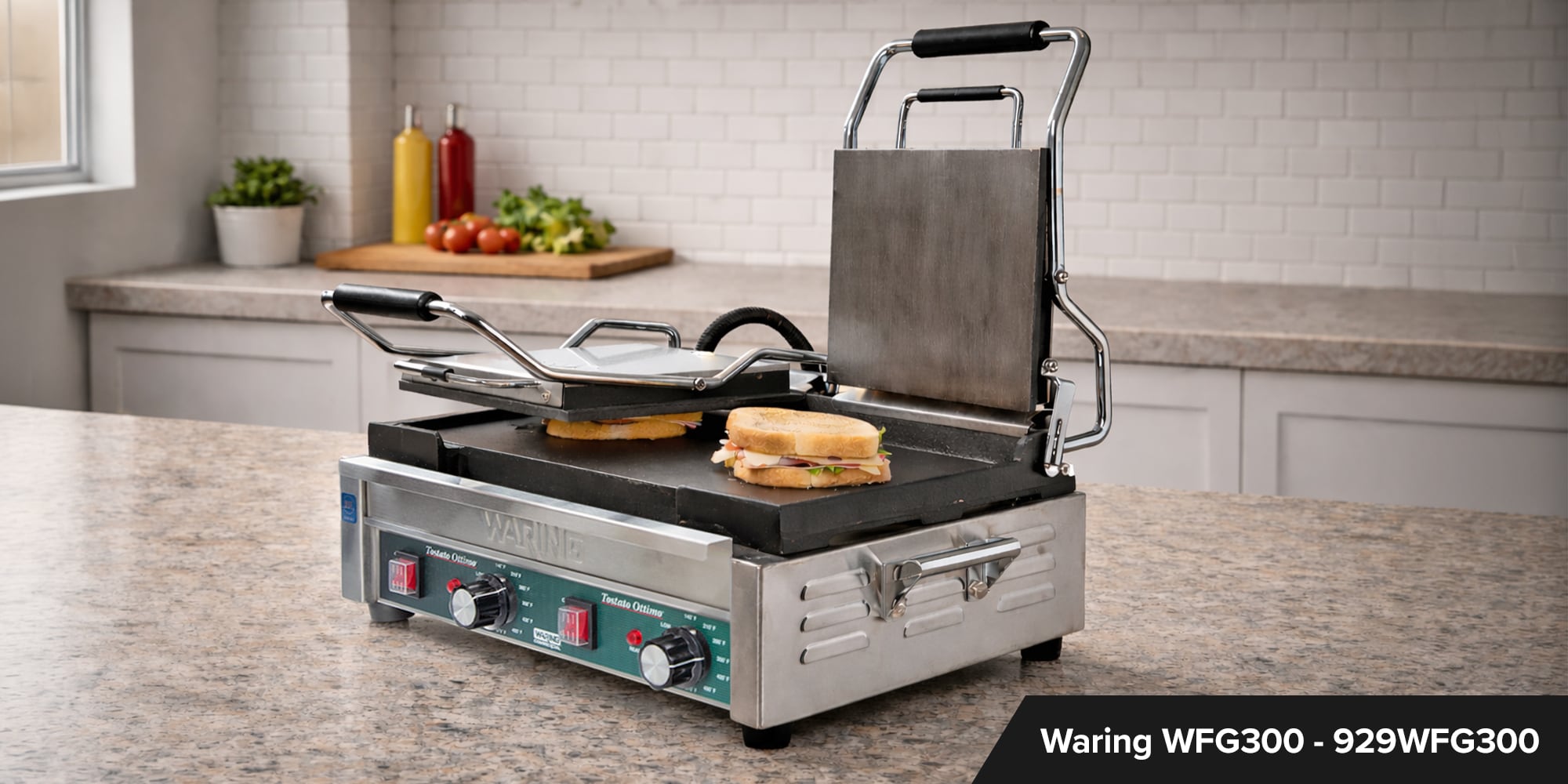
For operations that need more output than a standard single press, the Waring WFG300 is a strong dual panini grill because it combines a larger 17" x 9 1/4" cooking surface with dual thermostats that let staff cook multiple items at once or run different temperatures side by side. Its smooth cast iron top and bottom plates provide even contact for uniform browning, while the 240V design, removable drip tray, adjustable back feet, and included heavy-duty grill brush make it a practical fit for establishments working through steady lunch traffic.
Shop the Waring WFG300 Tostato Ottimo Smooth Top & Bottom Dual Panini Sandwich Grill | $1,079.00
Runner Up: Avantco PG400S Commercial Dual Panini Sandwich Grill with Smooth Plates
- Smooth plates promote even heat distribution and consistent browning across pressed items
- Dual thermostats allow operators to run two different temperatures at once
- Adjustable back feet, a removable drip tray, and the included heavy-duty grill brush streamline grease management
- Users report the top plate tension may need periodic tightening
- Users report switch durability issues after extended near-daily use
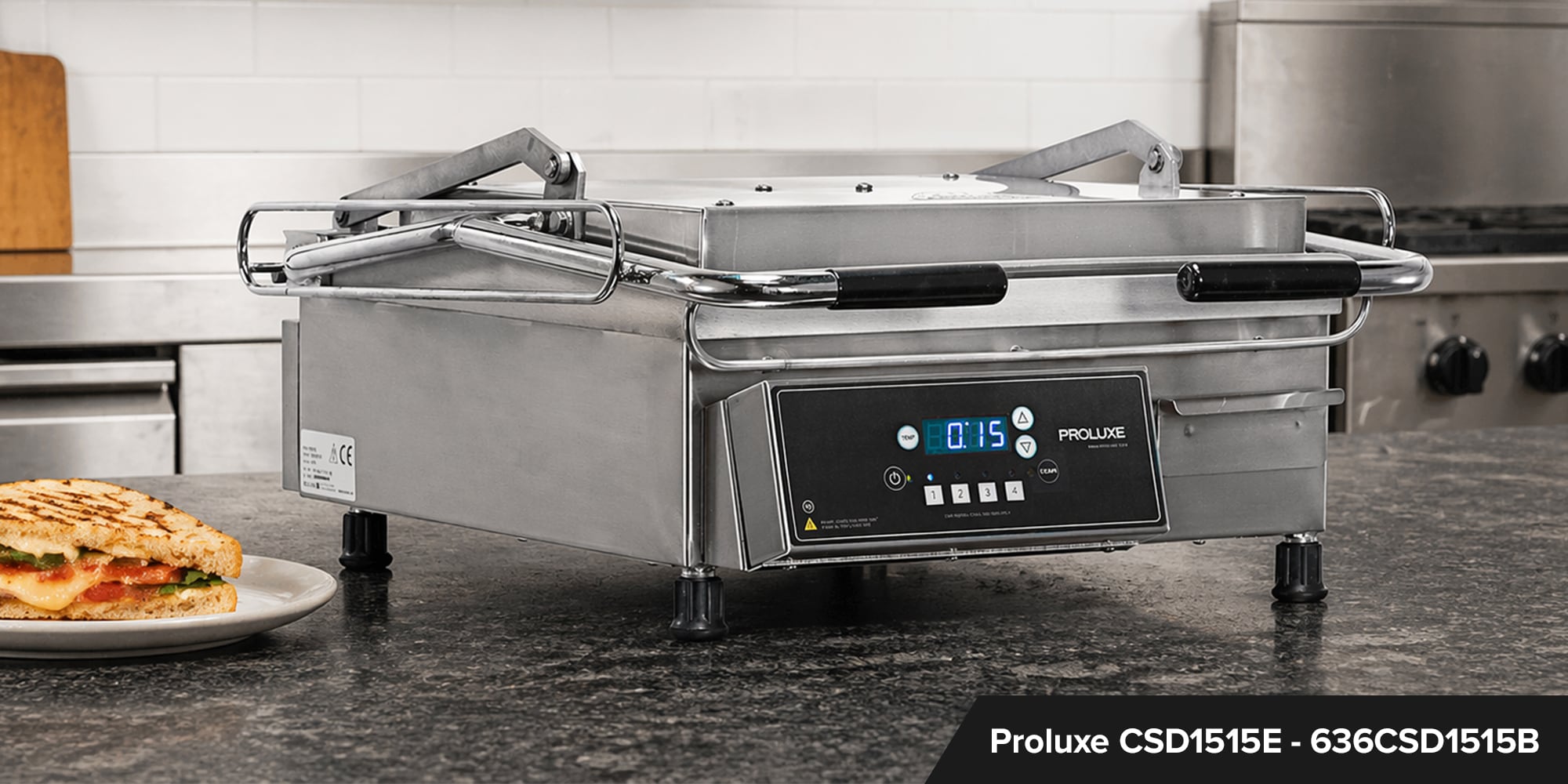
The Proluxe CSD1515E stands out as a top digital panini grill since it combines digital controls and a programmable timer with a heavy-duty 15" x 15" smooth clamshell cooking surface. It is built for sandwiches, wraps, and burritos, with embedded heating elements, EvenHeat distribution technology, a self-leveling lower plate, and high-temperature operation that helps the unit recover quickly in high-volume service.
Shop the Proluxe CSD1515E Vantage CS Heavy-Duty Clamshell Sandwich Grill | $3,569.00
Read customer reviews for the Proluxe CSD1515E Vantage CS heavy-duty clamshell sandwich grill.
- Digital controls and a programmable timer make it easier to standardize cook times
- Large enough to handle multiple items at once
- Hidden conduits are designed not to collect grease and crumbs the way exposed components can
- Rated for heavy-duty use
- Food can stick unless the unit is used with the brand's recommended release spray
- Larger fixed-position unit that makes more sense for a dedicated sandwich station than for cramped or frequently reconfigured prep areas
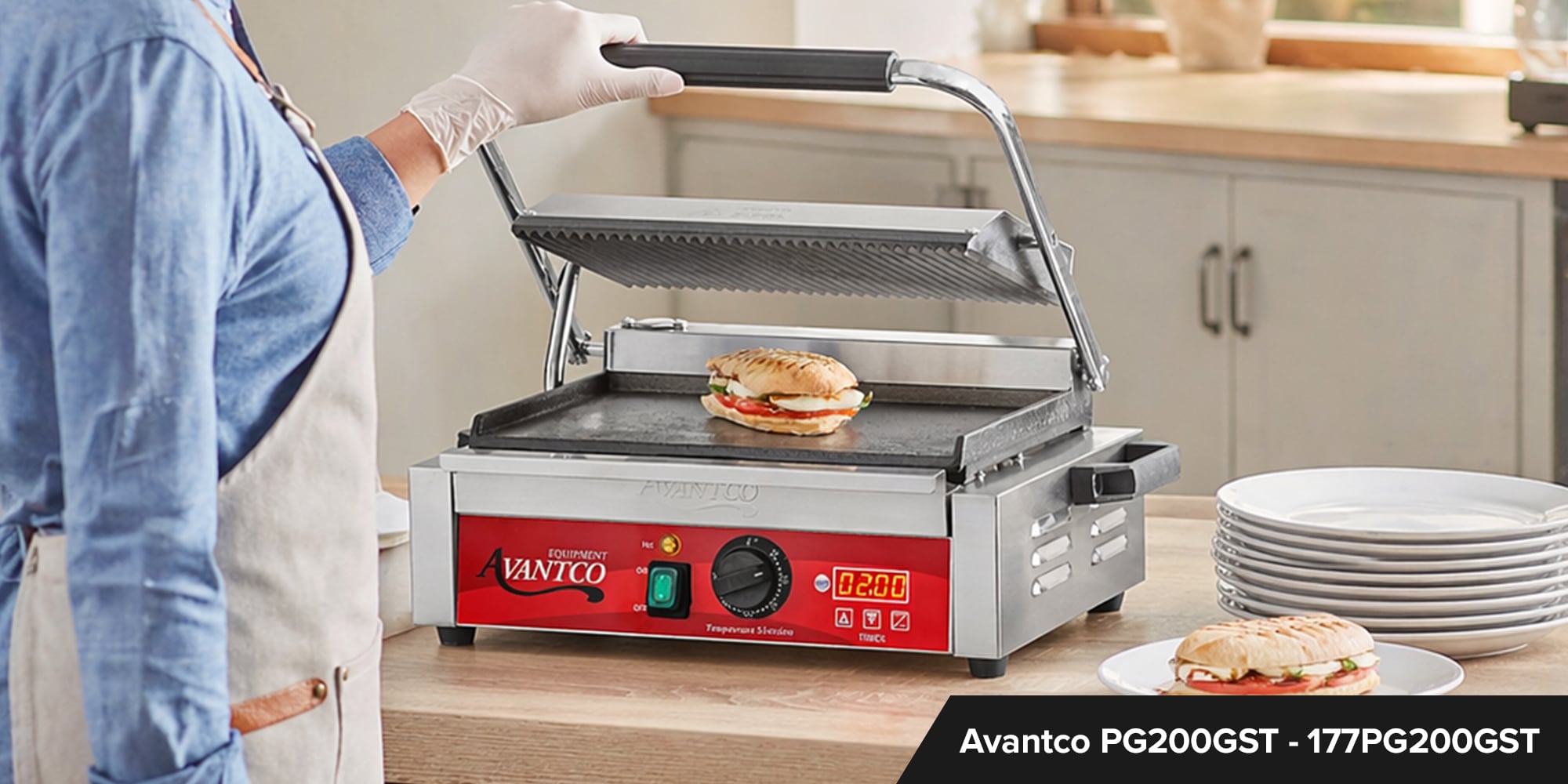
For operators who need an affordable sandwich press without giving up core performance, the Avantco PG200GST is a strong budget panini grill. It pairs a compact footprint with a grooved top plate, smooth bottom plate, and a programmable timer. Its 13 3/8" x 8 3/4" cooking surface, adjustable temperature range, and specialized hinge that lets the top plate rest flat against the food make it a practical fit for lighter-volume lunch programs.
- Grooved top and smooth bottom plates give operators visible grill marks on top with even contact and browning underneath
- Adjustable heat from 120 to 570 degrees Fahrenheit
- Included removable grease tray helps simplify cleanup between batches
- Users report that it heats quickly, is easy to clean, and holds up well over time
- Better suited to smaller sandwich volumes
- Offers less precision than higher-end programmable models
- Cast iron plates require proper care, and heavy-duty cleaners can strip the seasoning
How We Chose These Commercial Panini Grills
To choose a commercial panini grill, start with the way your kitchen intends on using it. Consider what you are pressing, how many orders you need to turn during a rush, what kind of finish you want on the bread, and how much control your staff needs over heat and timing. We weighed each model against the factors that most directly affect day-to-day performance in a commercial setting: use case, plate material, plate configuration, size, and controls. Those details shape everything from recovery and consistency to footprint, throughput, and the final look of the sandwich.
Use
Not every panini grill is built for the same job. Some are mainly geared toward classic pressed sandwiches, while others are also suited to burgers, quesadillas, breakfast items, wraps, burritos, chicken, and vegetables, so we favored models whose plate style, output, and control package matched a clear commercial use case rather than trying to do everything equally well.
Plate Material
Plate material changes how the grill behaves during service, making it an important consideration. Aluminum and cast iron are both common, but they serve different needs on the line.
- Aluminum Plates: Aluminum heats up quickly, which makes it a practical choice for lighter, more sporadic use or for operators who want fast response from a digitally controlled grill.
- Cast Iron Plates: Cast iron takes longer to come up to temperature, but it holds heat longer and is the better fit for steady, continuous production.
Plate Configuration
Plate configuration affects both presentation and contact with the food. You can determine whether a grill prioritizes visible grill marks, full-surface browning, or a compromise between the two.
- Grooved Top and Bottom: If presentation depends on a ribbed finish on both sides, this configuration makes the most sense. It leans furthest into a traditional grilled-panini look and works well for menus where visible grill marks are part of the appeal.
- Smooth Top and Bottom: Smooth plates provide complete contact across the sandwich, which helps produce more uniform browning and an even press. That makes them especially useful for sandwiches, wraps, quesadillas, and burritos where full-surface heating matters more than grill marks.
- Grooved Top and Smooth Bottom: This setup gives operators a middle ground. The grooved top adds grill marks and a more defined pressed look, while the smooth bottom keeps more complete contact with the bread for even browning underneath.
Size
Size matters because it determines both output and how much counter space you give up. Single grills are usually the better fit for smaller cafes, concession stands, or lower-volume sandwich programs, while dual units make more sense when you need extra production capacity or want to cook multiple items side by side during busy service.
- Single Panini Grills: A single unit keeps the footprint smaller and is often enough for operations with a tighter menu or lighter sandwich volume.
- Dual Panini Grills: Dual models add surface area and can improve throughput; in some cases, they also allow staff to run two temperatures at once for better flexibility on a mixed menu.
Controls
Control style has a direct impact on consistency. Consider both traditional dial controls and digital systems because the right choice depends on whether your operation values simplicity first or tighter precision across shifts and staff.
- Dial Controls: Dial controls are straightforward, familiar, and easy to train on, which makes them a strong fit for standard sandwich programs and kitchens that do not need a more advanced interface.
- Digital Controls: Digital controls offer more precision, and when paired with programmable timers they make it easier to standardize cook times and reduce overcooking during rush periods.
The right commercial panini grill can improve ticket times, expand your hot sandwich offerings, and help your staff turn out more consistent food throughout service. Whether you need a compact unit for a cafe counter or a higher-output model for a busy sandwich line, choosing a grill that fits your menu, volume, and workspace can make a noticeable difference in both efficiency and product quality.
Related Resources

October 2026 WebstaurantStore Coupon Code
Fall flavors are in full swing, and the deals at WebstaurantStore are just as irresistible! Stock up on everything your kitchen needs for a busy stretch of autumn, from disposables and pantry staples to equipment that keeps service moving. Browse our featured sale items below, and use code SPICE26 at checkout to save up to 20% on your purchase. Hot drinks, cozy desserts, and warm soups take center stage this time of year, so there's plenty here to fuel your seasonal menu. Sign up for our emails to get exclusive deals and coupon codes delivered straight to your inbox! Looking to save even more? Check out the new Webstaurant Rewards® Visa Business Card ! Sign up for a new card today and start earning rewards on every WebstaurantStore purchase
Best Commercial Grill Reviews
Whether you manage a steakhouse, a BBQ restaurant, or are preparing grilled foods on-site for catering , finding the right commercial grill is an essential part of preparing perfect meats. You want to find a grill that matches your culinary needs, your restaurant concept , and your budget. Not only will the right grill elevate the quality of your burgers and steaks, but you'll be able to achieve the perfect level of doneness your customers want while providing quick, convenient service. We'll outline the best commercial grills based on extensive research and feedback from our foodservice professionals to help you make an informed purchase. Shop All Commercial Outdoor Grills Check out our top choices for the best commercial grills: Best Comm

Griddle vs Grill
Commercial griddles and grills are two of the most common cooking equipment types used to build fast, efficient hot lines in foodservice operations. From breakfast service to burger stations, both units play a major role in how operators cook menu items consistently and keep up with demand. Choosing the right equipment starts with understanding how these machines function in a commercial setting, what kinds of foods they support, and how they fit into the workflow. A solid understanding of their uses and capabilities makes it easier to invest in equipment that supports both the menu and the day-to-day pace of service. Use these links to learn more about griddles and grills: What Is a Griddle? What Is a Grill? Differences Between Griddles an
Join Our Mailing List
Receive coupon codes and more right to your inbox.