
- Topics 1586
- Industrial 59
- Troubleshooting Guides 32
- Restaurant Management 145
- Bar Management 70
- Catering Tips 47
- Bakery Management 44
- Food Trucks & Concessions 40
- Advertising & Marketing 41
- Eco-Friendly Tips 13
- Facility Layout & Design 48
- Coffee Shop Tips 32
- Installation & Maintenance 63
- Janitorial & Pest Control 35
- Safety & Sanitation 122
- Startup Tips 112
- Menu Design 11
- Kitchen & Cooking Tips 108
- Hospitality Management 27
- Pizza & Sandwich Shop Tips 21
- Smallwares 42
- Food Prep 103
- Tabletop Items 21
- Disposables 28
- Calculators & Tools 7
- Consumables 77
- Warewashing & Laundry 22
- Cooking Equipment 108
- Food Storage & Refrigeration 59
- Beverage Equipment 43
- Office Supplies 6

Saucepans are found in countless commercial kitchens, allowing chefs to prepare sauces, pasta, soups and stews, and a range of other recipes. While they are ideal for liquid ingredients, these versatile pans can be used for a variety of different cooking styles, including simmering, boiling, reducing, and even searing. Given the diverse and dynamic needs of a foodservice establishment, understanding the different types and variations of saucepans available is critical. We'll outline key considerations such as size, width, and material so you can make an informed purchase and provide your staff with the right tools for your menu.
Shop All Saucepans
While the terms saucepan and saucier are frequently used interchangeably, there are subtle differences that set the two apart. The most noticeable difference between sauce pans and sauciers lies in their construction and the types of foods they are used for. When deciding between a saucepan and a saucier for your commercial kitchen, consider the types of dishes you frequently prepare and the level of precision required in your cooking.
- Saucepans: A saucepan is designed specifically for boiling, simmering, or reducing liquids, sauces, and small batches of food, and is ideal for preparing foods that require time to cook properly. Featuring high sides and a flat bottom, saucepans provide a fixed structure that helps trap heat and reduce evaporation during cooking. This design provides enhanced heat retention and even heat distribution, ensuring that your sauces are thoroughly cooked to perfection.
- Sauciers: A saucier is a specialized pan designed specifically for handling delicate sauces or recipes that require precise temperature control and constant stirring. They feature a rounded bottom, which helps to prevent sauces from sticking to the corners or burning. Additionally, the sloped, curved sides of a saucier make it easy to whisk and stir your sauces.
A saucepan's size is determined by its capacity, diameter, and shape, all of which play a significant role in its functionality and versatility. Saucepan capacities range from small to extra-large, and they can typically hold between 1 and 7 quarts of product, depending on which option you choose. Check out the applications and benefits of each saucepan capacity below. From making French mother sauces to cooking pasta, having a range of saucepan sizes available provides you with everything you need to handle the intricacies of your menu.
Small Capacity Saucepans
Small saucepans are typically suggested for use in small cafes and delis. However, they can also be beneficial for larger institutions when preparing a small specialty dish. These saucepans are ideal for serving individual portions without the risk of risk of cross-contamination.
- Capacity: 1-2.75 qt.
- Applications: Use for small portions of soups, sauces, and gravies. They're also perfect for individual servings, like a gluten-free dessert for one or two guests.
Medium Capacity Saucepans
Medium saucepans are an ideal choice for handling hearty batches of food without being excessively large for their intended use. It is recommended that all types of establishments, regardless of their size, have a medium-sized saucepan in their kitchen due to its versatility and practicality.
- Capacity: 3-4.5 qt.
- Applications: Use to handle multiple servings of grains, mashed potatoes, and blanched vegetables, as well as a heavy custard or cream topping.
Large Capacity Saucepans
Large pans are designed for cooking food in large batches. They are particularly beneficial for businesses like casual to upscale restaurants that expect high demand, catering companies that prepare food for large groups, and buffets, where keeping your steam tables filled with fresh options is a must.
- Capacity: 5-7 qt.
- Applications: Use for making pasta sauce, chicken stock, or a specialty soup.
Extra-Large Capacity Saucepans
Extra-large saucepans are particularly well-suited for establishments that specialize in serving a limited selection of main dishes. These versatile cookware items are perfect for preparing meals in large quantities and making components of dishes used across various menu items, such as pasta sauces. Cafeterias, hospitals, and schools can take advantage of the generous size of these saucepans to efficiently cook for large groups. Additionally, typical restaurants can benefit from using these pans to prepare bulk quantities of popular specialty dishes that have a high turnover rate.
- Capacity: 7+ qt.
- Applications: Use for making large quantities of stew, pasta sauce, blanching larger vegetables, or steaming crab legs.
The type of handle used on your saucepans impacts how easy the pan is to hold and maneuver while cooking. Some handles are optimized for comfort, while others prioritize functionality and support. These handles are categorized by how they are attached to the pan, how easy they are to clean, and the level of durability they offer. We'll outline the major types of saucepan handles so you can make the right choice for your kitchen.
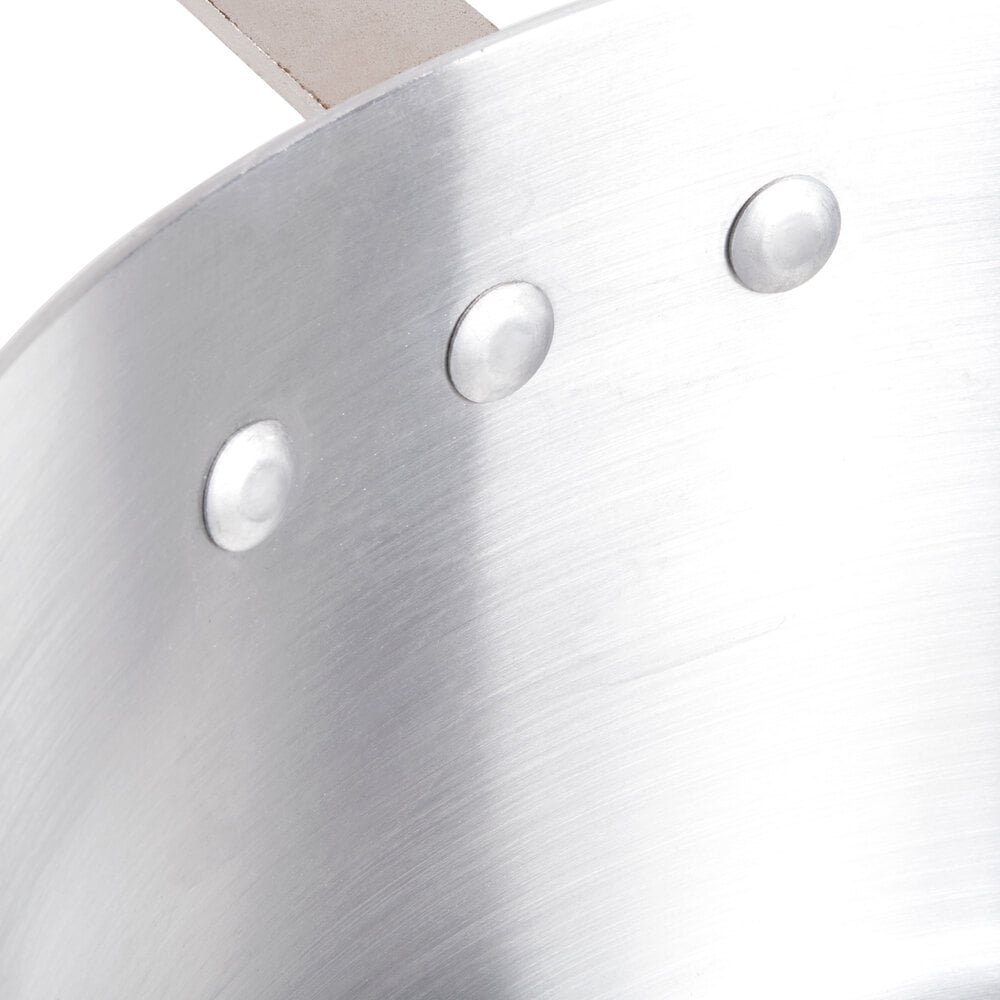
1. Riveted Handle
Usually connected by 2 or 3 pieces of hardware or rivets, riveted handles provide an excellent connection between the handle and pan. However, these rivets can easily catch or hold food, which makes cleaning more difficult. So while riveted handles are the most sturdy option, they are less sanitary than a welded handle. It is suggested to choose this type of handle for your heavy pans.
- Strongest connection; made to last in commercial environments
- Difficult to clean; can house bacteria
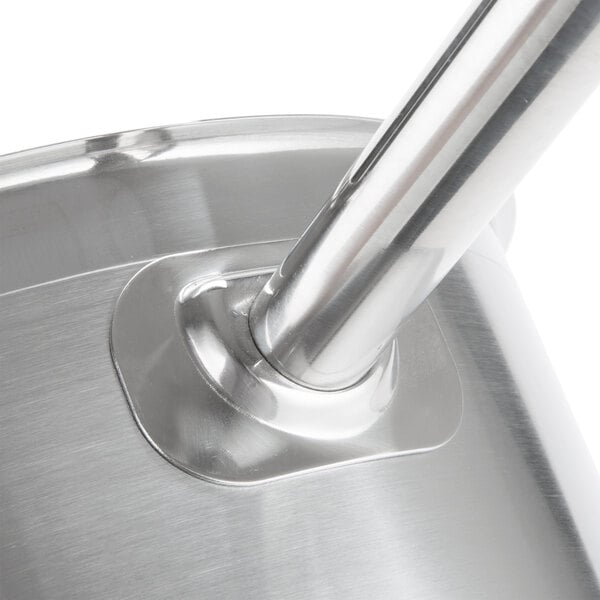
2. Welded Handle
This handle is melted or welded to the pan during construction to provide a sturdy connection. The process results in a completely smooth interior on the pan and no space or crevices for food or bacteria to get stuck. Welded handles are less sturdy than riveted handles, but they are more sanitary. It's best to choose these handles for medium- to light-duty pans.
- Sanitary and easy-to-clean
- Connection is less secure when handling heavy pans
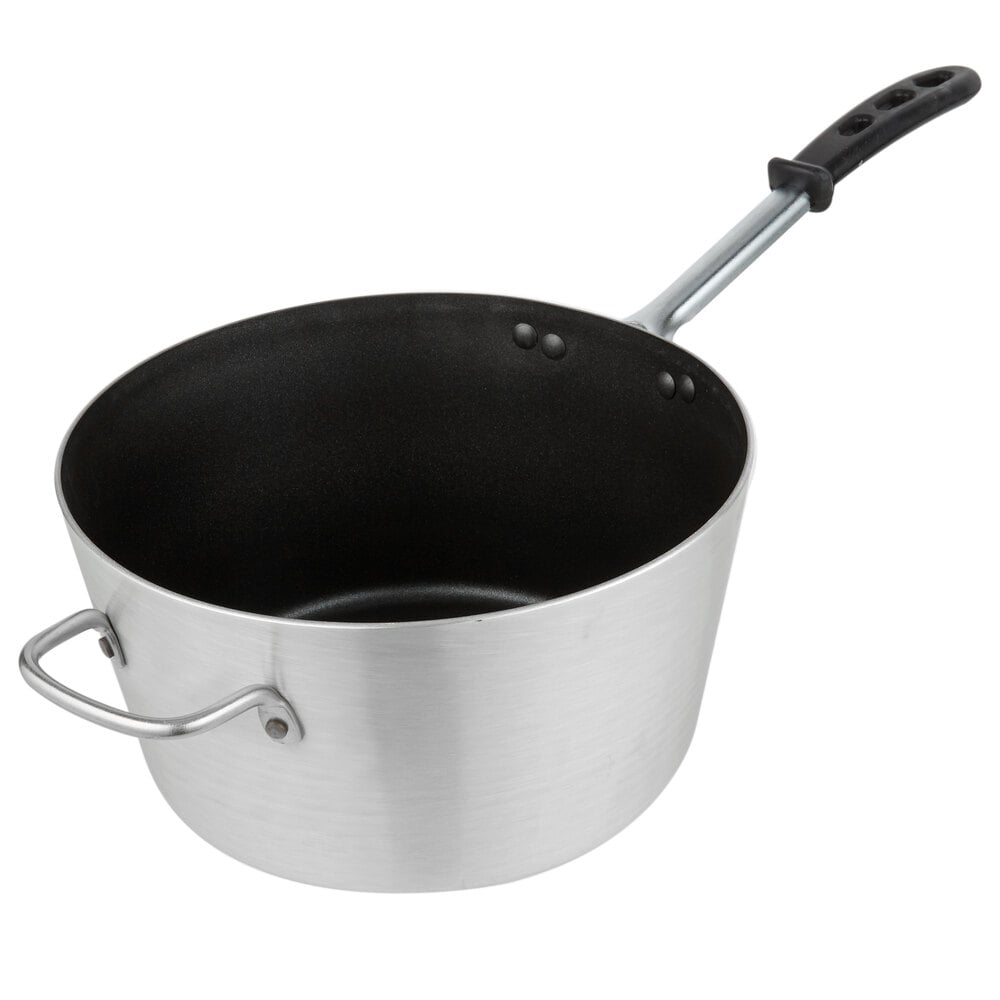
3. Helper Handle
A helper handle is a loop handle placed opposite the long handle on a pan. This extra handle lets you steady a pan during transport to put less strain on the main handle as well as less strain on your chef's wrist. Since it's designed to help carry heavy foods, you will primarily only see this handle on larger pans.
- Provides extra support
- Takes up more space during storage and while on a stovetop

4. Hollow Handle
Air is one of the best insulators out there - hollow handles take advantage of this by creating a hollow tube that stays cool much longer when connected to a saucepan. These handles are better insulated than the typical solid metal handles you'll see. Likewise, they are lighter in weight and so contribute to an overall lighter pan.
- Stays cooler while cooking
- Will not fit typical handle covers

Saucepans can be loosely grouped into two categories, narrow and wide, each with its own set of advantages and ideal uses. The right diameter for your kitchen depends on what kinds of sauces you typically make and how much you expect to make at once. In general, it's a good practice to have a selection of both narrow and wide saucepans on hand to accommodate your culinary needs.
- Narrow saucepans: Narrow saucepans have a smaller diameter, ensuring that less food comes into direct contact with the hottest part of the pan. They excel at tasks like boiling and simmering ingredients. Additionally, their design aids moisture retention, helping sauces achieve the right consistency and ensuring ingredients blend properly.
- Wide saucepans: Wide saucepans offer a larger cooking surface and heat up faster and more evenly than their narrow counterparts. This makes them ideal for tasks such as braising, searing, or rapid reduction. The wide surface area allows for more even cooking and better heat distribution, making them versatile for a variety of cooking techniques.

The two main options you'll encounter are straight sides and tapered sides. When deciding between the two, consider the types of foods on your menu and your staff's cooking preferences. Choosing the right style of sides can enhance the efficiency and quality of your cooking processes, ultimately leading to better results in your commercial kitchen.
- Straight saucepans: Straight-sided saucepans are designed for versatile cooking, offering better heat conduction. With sides that go directly up into the air, these pans distribute heat evenly, allowing for efficient cooking. If you're looking to accelerate the cooking process, use a straight-sided pan that comes with a fitted lid.
- Tapered saucepans: Saucepans with tapered sides are ideal for dishes that require frequent stirring. The flared-out design of tapered saucepans allows food to move within the pan without the risk of spills, making them perfect for recipes that need to be cooked at a consistent low temperature.
Like most types of cookware, saucepans are made from a range of materials. Whether you're looking for superior heat retention, enhanced durability, or easy cleaning, each option has its own set of benefits. Carefully examine the needs of your menu and evaluate kitchen equipment specifications while comparing which material best fits your needs.
- Aluminum saucepans: With a standard silver color, aluminum saucepans are a popular, economical option perfect for start-up restaurants, cafes, and diners. They are light weight and excellent heat conductors, but may discolor light-colored foods and are less durable than other options.
- Stainless steel saucepans: Stainless steel saucepans also feature a standard silver color, while adding extra durability and weight that aluminum pans simply can't compete with. They are non-reactive, extremely durable and rust-resistant, and induction-ready, but are prone to hot spots.
- Copper saucepans: Most often used for display cooking, copper saucepans have a distinctive orange-red color. They will occasionally have a stainless steel handle to ensure reliable transportation. They are the best option for conducting heat and offer visual appeal for display cooking, but come with the highest cost, react chemically with select foods, and are easily dented.
- Aluminum-clad bottom saucepans: Aluminum-clad bottom saucepans are made of stainless steel but have a few millimeters of aluminum permanently adhered to the bottom to better distribute heat. They distribute heat evenly and effectively, but come with a heavier weight that can make them difficult to handle.
- Stainless steel-clad saucepans: A stainless steel-clad saucepan is made of aluminum with a few millimeters of stainless steel on the bottom of the pan. They offer a light weight alternative to traditional stainless steel pans and are induction-ready, but are poor heat conductors and prone to hot spots.
- Non-stick saucepans: With their main feature being a non-stick surface, non-stick saucepans also typically have a black interior for easy identification. This interior is a coating of PTFE or Teflon®. The downside of these pans is their dark interior, which can disguise the true color of food and lead to over-browning. Additionally, they are easy to scratch.
- Tri-ply saucepans: Tri-ply means that there are three layers of material: the outer two layers are made of stainless steel, and the interior layer, or "core," is made of aluminum. Some tri-ply saucepans only have the tri-ply construction on the bottom, the rest of the pan having a typical single-layer construction, while other pans have the tri-ply design on the bottom and sides. These pans are nonreactive, induction-ready, and boast improved heat conduction, but come with a heavier design.
Thickness impacts the durability and heat retention capabilities of your saucepan. You will see the thickness described in either millimeters (mm) or as a gauge. Millimeters are a straightforward measure of how thick the material is. Gauge operates in reverse, with higher numbers corresponding to thinner materials and lower numbers corresponding to thicker materials. For saucepans, 22 is about as thin as advisable. On the other hand, the heavy-duty saucepans can have a gauge of 8. Typically, it is standard to have a pan with a gauge from 16-20. The advantages of a thin pan are the economical price point, the fast heat times, and the light weight feel. But the thicker the pan, the more durable it is, and the longer it is likely to last in fast-paced environments where pans get dropped, bumped, and generally abused in everyday use.
- Light weight saucepan benefits: Lighter pans are easy to maneuver, even when filled with food, making them an ergonomic choice for chefs and dishwashers. The trade-off is that light weight pans tend to have a thinner construction, which is easier to bend or ding. In some cases, if the rim is bent, a lid will no longer fit on the pan.
- Heavy saucepan benefits: Durable, heavy saucepans will not dent easily, making them a long-lasting investment. The compromise here is that chefs may struggle to lift and carry heavy pans filled with heavy foods around the kitchen. To help with this, try getting a pan that has a helper handle to help offset the weight while carrying.

Over his 5+ years with WebstaurantStore, Jason has spent countless hours learning, researching, and writing about the foodservice industry. With expertise in technical topics, he takes pride in helping customers and readers understand everything from troubleshooting their equipment to the fundamentals of starting a business.
Learn more about this author and WebstaurantStore's Content Writing Team here!
Related Resources

August 2026 WebstaurantStore Coupon Code
As summer winds down, the savings at WebstaurantStore are still breezing along all August long! Take advantage of incredible deals on the supplies and equipment your business needs to stay stocked and ready for every shift. Browse the featured sale items below, and don't forget to enter coupon code BREEZE26 at checkout to save up to 15% on your purchase. Don't miss your chance to take advantage of these limited-time August savings! Looking to save even more? Check out the new Webstaurant Rewards® Visa Business Card ! Sign up for a new card today and start earning rewards on every WebstaurantStore purchase, and save on a WebstaurantPlus subscription. Use the code BREEZE26 for the items below to score great deals on restaurant disposables! Fr
Types of Pasta Sauce
Pasta is a celebrated dish, with the versatility that allows you to build whole menu concepts around it. But with hundreds of types of pasta to choose from, narrowing down the type of pasta sauce you’ll want to use can be a challenge. We’ll help you curate a delicious menu by explaining the 12 most popular types of pasta sauces along with which pasta noodles pair best with each. Click the following link to check out our printable pasta sauce chart . Shop All Pasta Sauces Click below to learn more about each type of pasta sauce: Marinara Sauce Alfredo Sauce Bolognese Sauce Vodka Sauce Pomodoro Sauce Pesto Sauce Carbonara Sauce Bechamel Sauce Arrabiata Sauce Amatriciana Sauce Cacio e Pepe Sauce Truffle Cream Sauce Different Pasta

Kitchen Equipment Every Restaurant Needs
Selecting the appropriate restaurant kitchen equipment is crucial for success when opening a new restaurant or renovating your existing business. Every concept, whether it’s a fast-casual cafe or fine dining restaurant, requires a tailored set of tools to operate efficiently and deliver consistent quality. This is where commercial kitchen design plays a key role, helping you align your equipment choices with your menu, workflow, and space constraints. We compiled a comprehensive list of essential restaurant equipment to provide a starting point for equipping your kitchen. Though this list serves as a foundation that encompasses the staples nearly every restaurant needs, you can expand it to meet your unique requirements. Download Equi
Join Our Mailing List
Receive coupon codes and more right to your inbox.