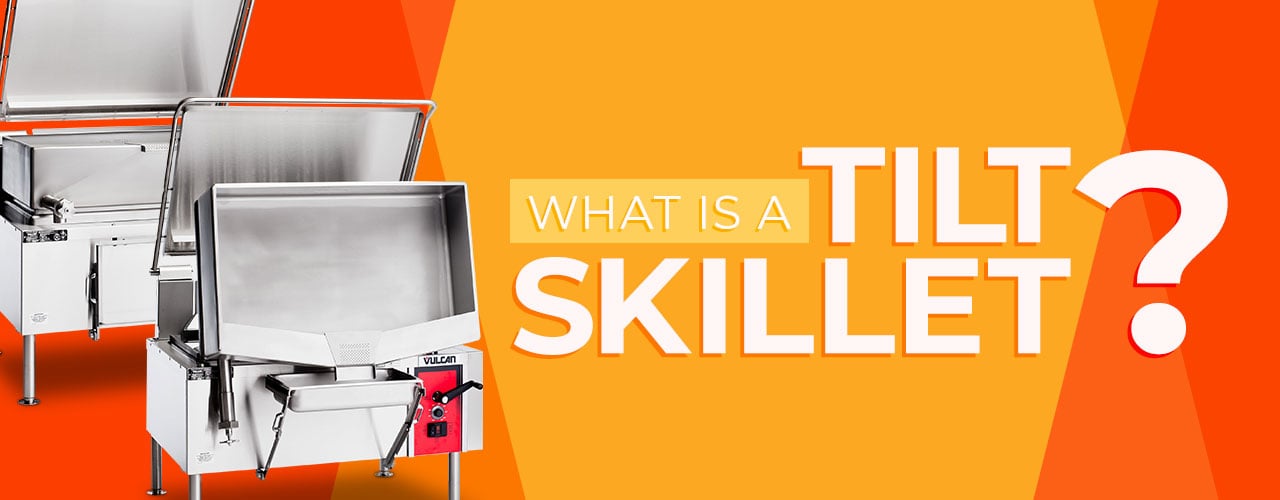
A tilt skillet is a versatile piece of commercial cooking equipment that allows the user to prepare a variety of foods in large batches. Also known as a braising pan, the tilt skillet can be used to fry, simmer, steam, saute, or grill. The most unique feature of a tilt skillet is the ability to tilt the braising pan forward to transfer foods into storage containers or serving dishes.
Shop All Tilt Skillets
How Does a Tilt Skillet Work?
Similar to a grill, a tilt skillet has control dials for setting the cooking temperature. But unlike a flat top grill with one cooking surface, the tilting skillet has a large pan with cooking surfaces on the bottom and side walls. Thanks to this feature, large quantities of ingredients can be added to the braising pan without overcrowding because they will cook from all sides.
As the ingredients are cooking, the included lid can be placed over the braising pan to reduce heat loss and save energy. When the ingredients are cooked, a lever allows the operator to tilt the braising pan forward and lock it into place. Foods can then be quickly and neatly poured into a separate container. This is extremely useful when transferring large quantities of food.
Uses of a Tilt Skillet
Prized for its versatility, a tilt skillet can do the work of several pieces of cooking equipment.
- Frying - The braising pan can be treated like a large frying pan and coated with oil for shallow frying foods.
- Steaming - By adding water to the bottom of the basin and closing the lid, you can steam a wide variety of foods like vegetables and rice.
- Grilling - The tilt skillet can grill anything you would normally put on a flat top, including eggs, bacon, pancakes, vegetables, and much more.
- Simmering and Boiling - Liquids can be simmered or boiled in a tilt skillet, allowing you to cook pasta, soups, and stews.
- Sauteing and Braising - Best known for its braising abilities, the tilting skillet can braise large quantities of meats.
- Holding and Proofing - The braising pan can even be used for holding, thanks to its great temperature retention.

Benefits of a Tilt Skillet
Tilt skillets offer an efficient means of cooking large batches of food, which makes them especially useful for commercial kitchens in schools, hotels, and hospitals. Not only limited to high-volume cooking, tilt skillets are also available in countertop models with smaller capacities. You can reap multiple benefits by adding a tilting skillet to your kitchen.
Easy to Operate
Anyone on your staff can operate a tilt skillet. They're extremely safe thanks to the tilt mechanism, which allows the user to transfer hot foods without contact.
Easy to Clean
Because the pan tilts forward, tilt skillets are easy to clean. Oil and grease can be drained off and the skillet can be sprayed down. Many tilt skillets come with an attached faucet for easy filling.
Efficient

Tilt skillets heat up very quickly and cook foods without much heat loss, which saves you money on utilities. They also offer an all-in-one solution because they do the work of multiple types of equipment.
Small Footprint
Even though they are designed for cooking large batches, a 40 gallon capacity tilt skillet still only takes up a relatively small footprint. Countertop units take up even less space, making them perfect for smaller kitchens.
Tilt skillets allow you to cook foods and transfer them quickly without any messes or spills. Compared to a flat top grill, a tilt skillet is self-contained and much more efficient. You can simplify your kitchen processes and boost your productivity by investing in a braising skillet for your kitchen.
Related Resources

Why You Should Buy Heavy Equipment Online
When opening a restaurant, most business owners rely on dealerships or cash and carry stores to purchase new equipment or supplies. While this has been the norm, purchasing large and expensive equipment online can be extremely cost-effective and time efficient. Simply shop for restaurant equipment like refrigerators, ovens, and ranges right from your computer or mobile device and have them delivered straight to the doors of your business. We’ll outline the advantages of buying restaurant equipment and supplies online and explain why choosing WebstaurantStore as your preferred option surpasses the benefits of going to a dealership, cash and carry store, or any other online store. Shop All Restaurant Equipment Nervous about shopping for restaurant equipment online? Check out these testimonials from business owners, Customer Solutions representatives, and distributors to see how WebstaurantStore makes it easy to buy heavy equipment online: <iframe width="560" height="315" src="https://www.youtube.com/embed/PRAZt6gDKrI?rel=0" frameborder="0" allowfullscreen></iframe> Benefits of Buying Restaurant Equipment Online Buying heavy equipment online doesn’t have to be intimidating. Below we have listed how this method can be beneficial to you and your business: Convenience: With just a few clicks, you can browse through a wide variety of heavy equipment options from the comfort of your own office or home. This eliminates the need to visit multiple physical stores, saving you time and effort. Specification and Price Comparison: Most online retailers provide detailed product descriptions, specifications, and customer reviews, enabling you to make an informed decision. This transparency ensures that you are getting the best value for your money. Broader Selection: Online retailers often have a larger inventory compared to brick-and-mortar stores. This means you have access to a wider range of options, including different brands, models, and price points. With more choices available, you can find the equipment that best suits your specific needs and budget. Cost Savings: Online retailers often offer competitive prices due to reduced overhead costs. They don't have to maintain physical stores or employ as many staff members, allowing them to pass on these savings to customers. Additionally, online retailers may offer discounts, promotions, or bundle deals, further reducing the overall cost of your purchase. Direct Delivery: This eliminates the need for transportation or hiring a moving company to transport the equipment from a physical store to your location. Online retailers typically offer shipping options, like parcel and common carrier delivery, and provide estimated delivery times, ensuring that you can plan accordingly. Buying Restaurant Equipment Online vs Traditional Dealerships When buying heavy restaurant equipment like ovens, ranges, and fryers, the restaurant dealership is the place that comes to mind for many people in the foodservice industry. A salesperson at a dealership might come to your business and take measurements, but, for restaurant operators that are looking for a more convenient and independent shopping experience, online shopping may be a better fit. Here are some great reasons to shop with WebstaurantStore instead: No Commission-Based Suggestions: Salespeople who work on commission may try to upsell you because their commission is based on the total amount of your purchase. Shopping online can help you avoid being guided to buying products you don’t really need in order to boost the bottom-line. Cut Out the Middleman: When purchasing from a dealership, there are more people involved in the process, increasing the chances of mistakes occurring along the way. With multiple individuals handling your purchase, there is a higher risk of errors being made, which can waste valuable time for your business. Shop on Your Time: Buying online offers the convenience of fitting into your own schedule. Dealerships have set business hours that may not align with your restaurant's operating hours. However, when shopping online, you have the flexibility to browse and place orders at your convenience. Buying Restaurant Equipment Online vs Cash and Carry Stores Cash and carry stores can be a convenient option for many restaurant owners and managers, because they can quickly stop in to pick up supplies, replacement components, or place orders. And while cash and carry stores are convenient, ordering on WebstaurantStore gives you a wider range of products and convenience. Below are some of the benefits of buying equipment with Webstaurant rather than at cash and carry stores: No Required Memberships: Some cash and carry stores may require customers to pay a club fee to shop at their location. At WebstaurantStore, we do not require a membership to make purchases. In fact, creating an account with us is completely free of charge! Avoid Overhead Costs: Maintaining physical storefronts comes with overhead costs, including building maintenance fees. These costs are eventually passed on to the customers, resulting in potentially higher prices. No Capacity Restraints: Physical stores have limited capacity and stock due to their size constraints. This means that they may only have a limited selection of a few thousand products available at any given time. In contrast, WebstaurantStore boasts an impressive inventory of over 400,000 products in warehouses across the nation. This vast selection provides our customers with a multitude of options to choose from. Buying Restaurant Equipment on WebstaurantStore vs Other Online Stores Purchasing heavy restaurant equipment online can help your business save time and money, and is much more convenient than traditional brick-and-mortar stores. But, how does WebstaurantStore compare to other online restaurant suppliers? Here's a few reasons that WebstaurantStore stands out from the rest: Low Prices: We offer highly competitive prices on restaurant equipment and supplies. Many sites will hike their prices to make it appear like they are offering free shipping. At WebstaurantStore, we give you the base price, so the more you buy, the better the bargain when it comes to your shipping cost. Vast Selection: With over 400,000 products on the site and distribution centers across the nation, we're sure to have exactly what your business needs. Quick Lead Times: Supply chain shortages have caused extensive lead times in the foodservice industry. WebstaurantStore invested in dedicated warehouse space to house more inventory and reduce lead times caused by dropship orders. Customization Options: Along with a larger catalog of products, we have the option to customize your order to fit your unique needs. Customer Reviews: Our products have thousands of reviews. Don't just take our word for it, you can read through reviews left by other customers. Auto-Reorder: Reordering is simple with our auto-reorder feature. WebstaurantStore auto reorder lets you conveniently schedule orders at regular intervals, so you can have essentials like paper towels, disposable cups and containers, and food items shipped to your business regularly. Scratch and Dent: We offer deals on fully-functional equipment with minor damages to help you save money. Visit the Scratch and Dent Outlet to find discounted prices on items with minor superficial flaws that won't affect performance. Optional Membership to Save More: A WebstaurantPlus membership helps your business save on shipping. Helping you cut costs even further, our WebstaurantPlus program offers free shipping for a low membership fee. Additionally, many large equipment items ship free whether you're a Plus member or not. While many restaurant owners and managers are used to ordering their restaurant equipment from traditional businesses like cash and carry stores and dealerships, ordering heavy equipment online is more convenient and can help you save money.
Restaurant Kitchen Layouts
While a dining room's design directly impacts guest experience, the layout of a restaurant kitchen is the foundation for its overall efficiency and success. Thoughtfully planning your kitchen layout enhances workflow, minimizes bottlenecks, and improves service quality. We outline the factors to consider when designing a kitchen layout that maximizes productivity. We also provide graphs of the most popular commercial kitchen layouts so you can visualize what will work best in your space. Shop All Restaurant Equipment Components of a Commercial Kitchen Most people hear "commercial kitchen" and think of the equipment they contain and the food they create. While those are pieces atop the board, operators design the board itself by creating distinct, organized sections in their kitchen that facilitate order and flow of service. Additionally, some restaurants may set up their kitchen to match their establishment's concept or design. Regardless of the style or layout, all commercial kitchens will have these components: Cleaning/Washing Section: The cleaning and washing section of a commercial kitchen includes appliances and products like sinks, warewashing machines, and drying racks. Three-compartment sinks are necessary for washing utensils, while warewashing machines can quickly clean plates and other serving vessels to keep the kitchen running at full speed. This section should be located near both the kitchen entrance and storage area, allowing servers to drop off dirty dishes and chefs to locate clean dishes with ease. Storage Section: The storage area can be split into non-food storage, cold storage, and dry storage. Within the non-food storage area, create sections for disposable products, cleaning supplies, and clean dishes from your cleaning/washing area. Remember, to avoid contamination, cleaning and sanitation chemicals cannot be stored above food, food equipment, utensils, dishes, or disposables. Cold storage houses items that require refrigeration or freezing, while dry storage includes all nonperishables and other consumables. This section can also contain a receiving area for inventory shipments, shortening the distance new stock must travel through your restaurant. Food Preparation Section: The food preparation area has sinks for washing produce, cutting areas, and mixing areas. Typically, the food preparation area is split into a section for processing raw foods (breaking down cuts of beef, for example) and a section for sorting foods into batches (chopping vegetables, mixing salad dressings, etc.). Placing this section near your storage area allows cooks to efficiently grab fresh dishes, prepare plates, and move them on to the cooking area quickly. Food Cooking Section: The meal cooking area is where main dishes are finished, so here you will have large pieces of equipment like ranges, ovens, and fryers. Like the food preparation area, the meal cooking area can be broken down into smaller sections, like a baking station, grilling station, and frying station. Because meals are finished here, the meal cooking area should be near the front of the kitchen, next to the service area. Service Section: The service area is the final section of a commercial kitchen. If you have a serving staff, this is where they will pick up finished dishes to take to customers. If you have a self-serve or buffet-style restaurant, this is where food will be displayed in warmers for customers to assemble their plates. This area must be located at the very front of the kitchen, just after the meal cooking area, to shorten the distance between completed meals and customers. Types of Commercial Kitchen Layouts There is no perfect formula for commercial kitchen layout. Every foodservice establishment is unique, so you must evaluate what will help you best meet your kitchen goals. That said, there are several basic commercial kitchen design layouts to consider that blend solid design principles and commercial concerns effectively. Think of these as templates rather than blueprints. Island-Style Kitchen Layout The island-style layout places the ovens, ranges, fryers, grills, and other principle cooking equipment together in one module at the center of the kitchen, while other sections of the kitchen are placed on the perimeter walls in the proper order to preserve a circular flow (any section can be the island, depending on what best suits your needs). This layout is very open and promotes communication and supervision, while leaving plenty of open floor space for easy cleaning. It works best in a large, square-shaped kitchen, but it can be modified to fit other shapes and sizes. Zone-Style Kitchen Layout The zone-style layout has the kitchen set up in blocks with the major equipment located along the walls. The sections follow the logical order for increased flow, giving you a dishwashing block, a storage block, a food prep block, etc. Communicating with and supervising your restaurant staff are not difficult in this layout because the center of the space is completely open. Assembly Line Kitchen Layout The assembly-line configuration is ideal for kitchens that need to serve a large quantity of people quickly, like cafeterias or correctional facilities. This layout may work better for establishments with a limited menu that serve large quantities of the same foods, like a sandwich or pizza shop, but it is viable for any type of kitchen. In this layout, kitchen equipment is organized in a line with the food preparation area at one end and the service area at the other, allowing cooks to quickly send food down the line. The cleaning/washing and storage/receiving areas can be located behind the assembly line to keep them out of the way. This creates supreme efficiency and keeps the kitchen open for excellent communication and flow. Often, kitchen equipment can be linked together, further eliminating wasted space. Galley Kitchen Layout The galley kitchen layout positions all stations and equipment along the kitchen walls. This layout resembles a hallway with counters running parallel on each side of the aisle. The name "galley" stems from its original use in boat kitchens. Ideal for limited square footage, galley layouts maximize space and are commonly found in boat, ghost kitchen, and food truck layouts. The galley kitchen layout is best suited to smaller menus and low- to mid-volume businesses, because the parallel workstations can become cramped, potentially extending food prep times. Open Kitchen Layout In restaurants, open kitchen layouts eliminate barriers between the kitchen and dining area, allowing patrons to observe food preparation firsthand. By showcasing the cooking process, it becomes an integral part of the overall dining experience. Each open kitchen layout is unique to the restaurant it serves; layouts vary based on factors such as square footage, types of cooking equipment, and culinary style. While open kitchen layouts promote quality control and ensure proper behavior among kitchen staff, they may also present challenges. The increased visibility and accessibility can lead to a louder environment, the release of food odors, and a raised risk of cross-contamination. Principles of Commercial Kitchen Design No matter which type of restaurant you operate, there are several objectives for designing a kitchen properly. According to the Certified Food Service Professionals handbook, there are six guidelines you should follow when creating a commercial kitchen design: Flexibility and Modularity: In a commercial kitchen, it is important to have a flexible layout that can easily adapt to changes. For example, if you update your menu with new dishes or bring in a new executive chef with different operating preferences, your kitchen layout should be able to accommodate these modifications. To create an adaptable workspace, consider incorporating multi-use workstations or movable equipment. By incorporating modular equipment and versatile storage solutions, the kitchen can easily accommodate different cooking methods and styles, making it more adaptable to evolving culinary trends. Simplicity: By prioritizing simplicity in kitchen design and equipment selection, you can create a more organized and efficient workspace for your foodservice operation. One effective way to streamline your kitchen is by strategically placing server stations near the kitchen area, reducing the need for frequent trips through the dining room. Additionally, incorporating modular or drop-in equipment can help eliminate unnecessary corners, edges, and shelving. Choose kitchen equipment with only the necessary accessories to save space and money in the long run. Flow of Materials and Personnel: By designing a kitchen with a logical layout that follows a circular pattern, employees and materials can move seamlessly without backtracking through the space. For example, refrigerated and dry storage areas should be located near the receiving area, while waste disposal and warewashing areas should be separate from food preparation and meal cooking areas. This separation ensures that completed meals exit the kitchen on one side, while soiled dishes enter on the other. Adhering to these principles not only promotes cleanliness and food safety but also eliminates confusion and establishes a well-organized and orderly system within the kitchen. Sanitation: The cornerstone of maintaining a clean and safe kitchen environment lies in adhering to health department codes mandated for all foodservice establishments. For instance, it is imperative to have designated hand-washing stations in every food preparation area, ensuring they are regularly cleaned and not used for storage purposes. This principle also applies to waste disposal areas. A practical strategy to facilitate proper cleaning in your kitchen is by incorporating casters on your worktables and equipment, facilitating easy movement for thorough cleaning of floors and walls. It is crucial to familiarize yourself with the specific regulations in your region to ensure that your kitchen meets the necessary compliance standards. Ease of Supervision: In the realm of kitchen management, the executive chef carries a significant load of responsibilities. This includes finalizing dishes, crafting menus, procuring supplies, overseeing food quality, and ensuring the proper functioning of equipment, all while supervising the kitchen staff. Opting for an open kitchen layout, characterized by minimal or no walls or partitions, can offer enhanced visibility, smoother navigation, and improved communication. Such a layout simplifies the task of supervision for your executive chef or general manager. Space Efficiency: To effectively utilize limited kitchen space in restaurants, carefully consider the placement of necessary equipment. When creating a small kitchen for food trucks or concession stands, prioritize countertop equipment and other compact products. For standard-sized kitchens with space constraints, identify the essential pieces of equipment. For instance, if your frying needs are minimal, opt for a light-duty countertop fryer over a larger floor model. Strike a balance between space-saving measures and ensuring that the kitchen is equipped with the necessary tools, as a lack of essential equipment can significantly impede production efficiency. How to Design a Commercial Kitchen When it comes to designing a restaurant kitchen, careful planning is essential to ensure maximum efficiency and productivity. A well-thought-out kitchen layout can streamline operations, optimize workflow, and ultimately contribute to the success of your establishment. Discover some of the most important aspects of a commercial kitchen you should consider when planning your kitchen design: 1. Lighting Lighting plays a crucial role in any kitchen setting, and commercial kitchens are no exception. Adequate lighting is essential to ensure the safety of your staff and the quality of your food. Bright and well-distributed restaurant lighting helps prevent accidents and enables chefs to accurately assess the color, texture, and freshness of ingredients. It is recommended to use energy-efficient LED lights, which provide excellent illumination and have a longer lifespan compared to traditional incandescent or fluorescent bulbs. 2. Spacing Space optimization is a fundamental aspect of commercial kitchen planning. The layout should be designed to maximize efficiency and minimize unnecessary movement. The cooking area should be equipped with the necessary appliances and have ample space for chefs to work comfortably. The preparation area should be located close to the cooking area, allowing for easy transfer of ingredients and reducing the time spent on food preparation. Finally, the storage area should be conveniently located near the cooking and preparation areas to facilitate quick access to ingredients and supplies. 3. Flooring The flooring material of a commercial kitchen should be durable, slip-resistant, and easy to clean. Given the high traffic and constant exposure to spills, grease, and heat, it is crucial to select a flooring material that can withstand these challenges. Common options for commercial kitchen flooring include quarry tile, epoxy resin, and vinyl composite tile. A well-designed restaurant kitchen layout is essential for any food service establishment's smooth and efficient operation. By considering factors such as flow, equipment positioning, space utilization, and safety, restaurant owners can create a workspace that promotes productivity and enhances the overall dining experience for their customers. Creating a comfortable and effective staff for your restaurant can help you retain your best employees.
Equipment Installation Checklist
When you invest in commercial kitchen equipment, ensuring a smooth installation process is crucial to the efficiency and longevity of your kitchen operations. Whether you are purchasing brand-new appliances or opting for pre-owned equipment, proper preparation for delivery is essential. To help streamline the installation process and safeguard your investment, we have compiled a comprehensive checklist for you to follow before and after the equipment arrives. Shop All Restaurant Equipment Pre Commercial Kitchen Equipment Installation Steps Preparing for equipment delivery and installation requires strategic planning and foresight. You need to know where your equipment will go, how you’ll receive it, and the details of your shipment. The size of your building, the availability of your staff, and the specific needs of your facility all play a role in the installation process. By checking these steps off your list, you can ensure the successful and efficient installation of your commercial kitchen equipment. 1. Strategize for Delivery A well-planned delivery not only benefits the delivery staff but also minimizes disruption to your daily operations. If you order through Webstaurant, you can select "Call Before Delivery" on our checkout page to receive a call from the carrier company to schedule a delivery window. We highly recommend taking advantage of this option. Mistimed or poorly organized equipment deliveries can result in food delivery and equipment installation crews competing for parking, staging areas, or dock and corridor access. Make sure someone is ready and properly equipped to receive it by focusing on the following details: Date and time: Before scheduling the delivery, consider how long installation will take and decide what time of day works best. Clearly mark when the delivery is arriving and notify your staff. Delivery equipment: Some equipment requires a dock or truck lift gate to be removed from a delivery vehicle. Logistical tools, such as dollies, cargo straps, and moving blankets, may be required. If you don’t own any, make arrangements to rent them. Delivery questions: Discuss any questions you have with the company shipping the equipment or the dealer you bought the equipment from before delivery day to make sure everyone is on the same page. 2. Prepare Your Facility In many cases, unloading and moving equipment can be the most physically demanding part of the installation process. If you can’t get the equipment through the door, you won’t be able to install it. Before making a purchase, assess the entryways and pathways leading to the installation site and your capabilities to move equipment through them. Measure doorways: The entrance door/delivery door must be large enough to accommodate the equipment shipment. If your restaurant has a loading bay, that might be the ideal location to move through. If your doorways aren’t wide enough, you can consider taking the doors off their hinges for extra space. Measure hallways: Measure the width of each hallway to ensure they offer enough space for the equipment to pass through. You should also make sure the hallways are wide enough and keep track of bends and curves that could impede equipment movement. Calculate elevator limitations: If the equipment must be placed on an elevator to reach its final installation point, the elevator must have enough capacity to handle the equipment. That requires measuring the elevator (inside volume + the size of the door opening) as well as the equipment. Every elevator is licensed for a specific weight limit that cannot be exceeded. 3. Confirm Utility Requirements Different buildings have different utility capabilities, so it is crucial to confirm that your equipment is compatible with the electricity, water, and gas supplies in your space, as well as the product's utility specifications. Electrical requirements: Make sure that the voltage and phase of the equipment being delivered match what your food service establishment provides. The amp requirements of the equipment being installed must match those of the service in the building. Confirm that the wiring and plug supplied with the equipment are both long enough and compatible with the electrical outlet if a plug is being used. Water requirements: Many pieces of equipment, such as steamers, steam-jacketed kettles, combi ovens, coffee urns, and dishwashers, require water for their basic operation. Verify that a water source is located close to, or at, the point of installation. Additionally, make sure there is sufficient water pressure and enough water available to meet demand. If you live in a hard water area, invest in a dependable water softener or water filtration system. You must also decide whether the equipment should be connected to the hot or cold water systems. Gas requirements: Confirm the gas requirements of the equipment being delivered match the natural gas or propane available at your facility. Gas pressure, as well as elevation, directly affect the effectiveness and efficiency of the equipment. At any significant elevation above sea level, the gas orifice found on all pieces of gas equipment must be calibrated and set to the elevation at which the piece of equipment is going to be installed. Click below for a downloadable restaurant equipment installation checklist: Download our Restaurant Equipment Installation Checklist PDF 4. Review Equipment Specifications Every unit of equipment is designed with different product specifications. While you might think equipment of a similar type would be the same, exact details about operation, maintenance, and best practices can vary significantly between brands. Review product documents, speak to a customer support representative, and do thorough research on equipment before purchasing it. Once you’ve scheduled a delivery, make all necessary arrangements to ensure safe, efficient operation. Hood requirements: If the new piece of equipment is going to be installed under a hood, you must make sure that the depth of the hood is large enough to properly accommodate it. You will need a minimum of 12" from the front edge of the cooking equipment to the front edge of the hood. To allow proper operation, make sure new or additional pieces of equipment have sufficient airflow (CFMs) through the hood once installed. Check out our resource on commercial kitchen hood code requirements for total compliance. Spec sheets: Check the manufacturer's specification sheet for any special installation requirements being recommended or required for proper installation. A "spec sheet" can generally be acquired through the manufacturer's website. If you purchase from WebstaurantStore, you can find equipment Specsheets in the Resources and Downloads section of the product's page. Local regulations: Understanding local foodservice regulations and codes is essential for installing commercial kitchen equipment. Familiarize yourself with local requirements such as specific certifications for equipment. Conducting research beforehand can help prevent potential issues and comply with the law. 5. Prepare Your Kitchen If your kitchen isn’t prepared for an equipment delivery, the installation process will be significantly impeded. Focus on clearing space and cleaning the area, making sure it's free of grime, debris, or anything that could impede your progress. Additionally, make any anticipated infrastructure and design changes before delivery, and consider implementing a new kitchen layout if necessary. Remove old equipment: You can't get the new equipment installed until the old equipment has been removed from the premises. If you know the new equipment is going to be delayed or if it arrives damaged or missing parts, you may need to move your existing kitchen appliances to one side of the kitchen, where they can be reinstalled if necessary. Set up a level mounting surface: Most pieces of equipment must be installed on a level surface to work properly, especially if they are freestanding models. Check the floors in your kitchen to make sure they are even. If they aren't, you can fill in low spots with self-leveling compounds or invest in equipment with adjustable legs. Post Commercial Kitchen Installation Steps Once your kitchen equipment has been delivered and installed, it might seem like the process is complete. However, there are still several important steps to take before you can fully resume standard kitchen operations. Proper documentation and testing are crucial aspects of ensuring the safe and effective use of your kitchen equipment. 1. Fill Out the Warranty Card A warranty card is a document that outlines the terms and conditions of your warranty coverage if your equipment requires repairs, replacements, or a refund. It serves as formal documentation of your warranty agreement, ensuring you receive the necessary support in case of any issues. Filling out the warranty card is straightforward, but it is essential to pay attention to the details and follow the manufacturer's instructions. As you read and complete the warranty card, here are some key considerations to keep in mind: Contact the dealer: If needed, seek assistance from the dealer to fill out all the information correctly. Return the card within the stated time frame: Make sure you return the warranty card to the dealer within the allotted time frame. Failure to do so could result in your warranty being void. Make a copy: Create a copy of the warranty card for your records in case you need to reference it. Voiding the warranty: Be aware of actions that could potentially void your warranty, such as unauthorized modifications, improper maintenance, or using the equipment for purposes outside of its intended use. 2. Follow the Instruction Manual Improper installation of equipment can cause significant damage, putting your workplace at risk of hazards and accidents, or even voiding your warranty. To ensure that your equipment functions optimally and safely, take the time to thoroughly read and understand the instruction manual before starting the installation process. Hire a third party: If necessary, consider hiring a third-party service to install your equipment. These professionals are trained to handle commercial-grade appliances and provide peace of mind that the job will be done right. Contact the manufacturer: Some manufacturers will send a registered technician to your location for professional installation. In doing so, they ensure everything is set up correctly and reduce the risk of you voiding your warranty. Clean the area: After the equipment is installed, properly dispose of all construction debris and packing materials. Confirm that packing materials have been removed from centers, burners, and small spaces in the equipment. 3. Equipment Demonstration A comprehensive equipment demonstration will familiarize your team with the equipment and promote safe kitchen operations. If you are well-versed in the operation and maintenance of the equipment, it is recommended to conduct a thorough demonstration for your staff. This live, hands-on presentation helps all team members understand proper usage and care practices, ensuring consistency and efficiency in your kitchen operations. If you are not confident in your knowledge of the equipment, schedule a demonstration with a manufacturer representative at the earliest opportunity. Startup and shutdown: Demonstrate how to turn the unit on and off, along with how to prepare it for use. Operation: Show how the unit works and how to cook with it. If it allows you to program specific recipes in, demonstrate how to access them. Cleaning: Educate your staff on the right way to clean and maintain the unit. By following these pre- and post-delivery steps, you can streamline the installation process, protect your equipment from damage, and ensure that your kitchen operations run smoothly. Proper preparation and attention to detail are key to maximizing the efficiency and longevity of your commercial kitchen equipment. <!-- Start Author Bio Block --> Written by Jason Kurtz Over his 5+ years with WebstaurantStore, Jason has spent countless hours learning, researching, and writing about the foodservice industry. With expertise in technical topics, he takes pride in helping customers and readers understand everything from troubleshooting their equipment to the fundamentals of starting a business. Learn more about this author and WebstaurantStore's Content Writing Team here! <!-- End Author Bio Block -->