- Topics 1577
- Industrial 59
- Troubleshooting Guides 32
- Restaurant Management 144
- Bar Management 70
- Catering Tips 46
- Bakery Management 45
- Food Trucks & Concessions 41
- Advertising & Marketing 41
- Eco-Friendly Tips 13
- Facility Layout & Design 47
- Coffee Shop Tips 32
- Installation & Maintenance 63
- Janitorial & Pest Control 34
- Safety & Sanitation 121
- Startup Tips 111
- Menu Design 11
- Kitchen & Cooking Tips 106
- Hospitality Management 26
- Pizza & Sandwich Shop Tips 23
- Smallwares 42
- Food Prep 102
- Tabletop Items 21
- Disposables 28
- Calculators & Tools 7
- Consumables 77
- Warewashing & Laundry 22
- Cooking Equipment 106
- Food Storage & Refrigeration 58
- Beverage Equipment 43
- Office Supplies 6

Meat slicers are essential tools in commercial kitchens, delis, and butcher shops for efficiently and precisely slicing various types of meats, cheeses, and vegetables. They typically consist of a sharp rotating blade mounted on a carriage that moves back and forth to slice through the food placed on the machine's tray. The thickness of the slices can be adjusted using a knob or dial, allowing operators to achieve the desired thickness for the meat or cheese they selected. Meat slicers streamline food preparation processes and ensure consistent slice thickness, resulting in uniform portions and improved presentation. In this guide, we will explore everything you need to know about meat slicers so you can select the best unit for your needs. Once you've determined which style you want, check out our commercial meat slicer reviews to select the exact unit you want to purchase.
Shop All Commercial Meat Slicers
Best Meat Slicers Video
Watch this video to discover the key features you should look for in a meat slicer. Whether you're a high-volume deli or a low-volume sandwich shop, this video will help you discover the right meat slicer for your business.
How to Choose a Commercial Meat Slicer
When purchasing a commercial food slicer, it's important to take into consideration exactly what (and how much) you intend to slice, as different units have different capabilities for slicing meats, cheeses, and vegetables. The production capacity of a meat slicer impacts its performance, durability, and overall value for your business. We explain the differences between entry-level, mid-level, and premium-level meat slicers so you can find the appropriate unit and enhance the overall productivity of your business.

Entry-Level Slicers
Entry-level meat slicers offer a significantly lower price tag than larger, heavier-duty models, but they will quickly burn out if consistently pushed beyond their capacity. They are best suited for operations where the slicer would be used for an hour or two at most per day. While designed for simple, safe operation, they are not recommended for slicing cheese and do not offer as many safety or convenience features as higher-end models.
- Operation: Manual
- Blade Size: 9" to 12"
- Horsepower: 1/16 to 1/3
- Cheese Slicing: Not recommended
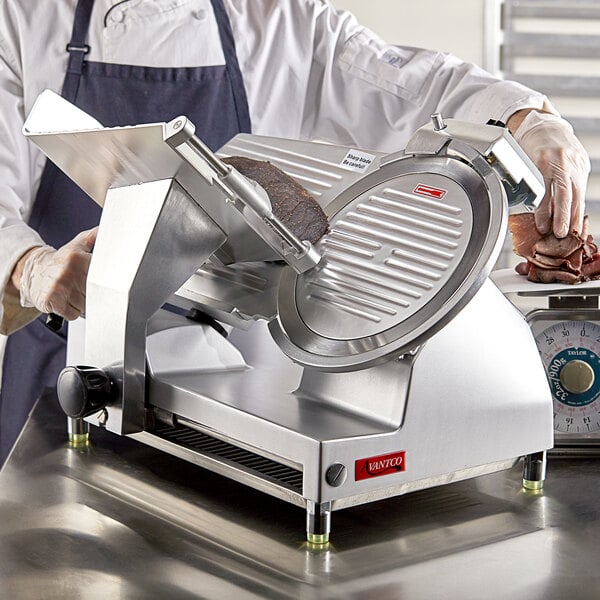
Mid-Tier Slicers
Mid-tier slicers generally have larger blades, a bit more horsepower, and can withstand more constant use than an entry-level model. While some models can handle occasional cheese slicing, they are primarily intended for a few hours of daily vegetable or deli meat slicing. They usually offer more safety and convenience features than an entry-level model. Depending on how much you use your deli slicer you could quickly make up the cost difference in increased productivity and safety between a mid-tier model and a less expensive option.
- Operation: Manual or automatic
- Blade Size: 10" to 14"
- Horsepower: 1/3 to 1/2
- Cheese Slicing: 1 to 2 hours per day
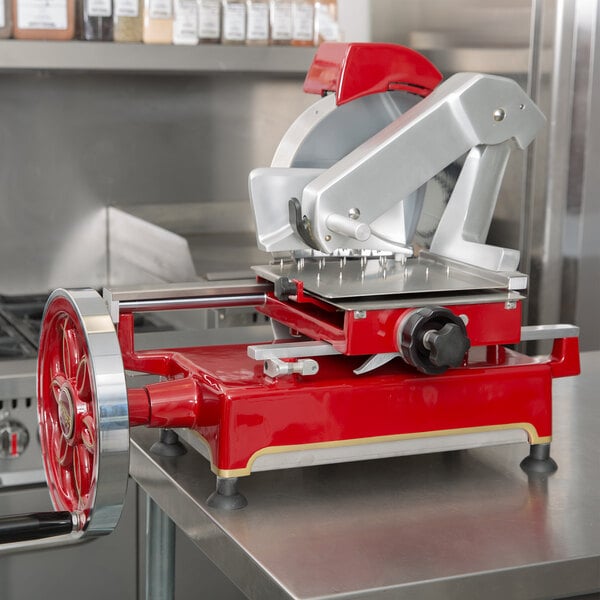
Premium Slicers
Premium slicers represent the top-of-the-line offerings from each of the commercial meat slicer brands. Most are designed for heavy-duty, constant use. They can typically slice cheese and create paper-thin pieces of prosciutto and other gourmet deli meats. Premium slicers offer design features that enhance the smoothness of operation, slice precision, and safe operation. Blending the "wow" factor of its show-piece nature with the precision performance, it's a great addition to a classic bistro or deli.
- Operation: Manual or automatic
- Blade Size: 13"
- Horsepower: 1/2
- Cheese Slicing: Continuous
Parts of a Meat Slicer
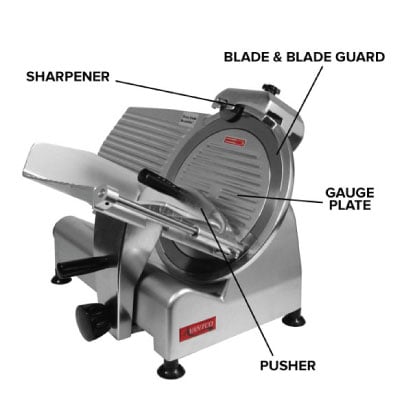
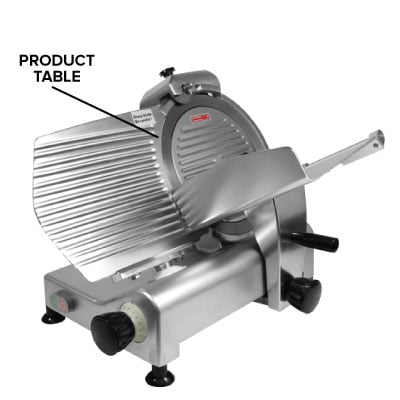
Commercial meat slicers all share the same basic components. Here's a quick rundown of commercial meat slicers' parts:
Product Table: Also called the carriage, or product tray, the product table is where you place the piece of meat, cheese, or vegetable to be sliced. It is often grooved and set at a specific angle so the product slides more easily toward the blade. On some models, this tilts up for easier cleaning.
Pusher: Also called "meat grip", the pusher is attached to the product table and holds the product still while you're slicing it. On some models, this is removable for easy cleaning.
Gauge Plate: This part surrounds the knife. When you adjust the thickness control knob, sometimes referred to as the index knob, this is what moves.
Sharpener: All slicers have a built-in blade sharpener to keep the blade razor-sharp and in perfect operating condition. On many, it's removable for cleaning.
Blade and Blade Guard: On most slicers, the blade is permanently attached to the unit. For safety, it's protected by a blade guard. The blade guard, or ring guard, is removable to varying degrees depending on the model. On some high-end models, the blade can be removed from the slicer using a special tool for a more thorough cleaning.
Meat Slicer Safety and Functional Features
When you're talking about a piece of equipment that's operated by hand and uses a razor-sharp spinning blade to slice products, safety cannot be understated. Proper training is essential for any employee who operates the slicer. Consider these safety and functionality features before making a purchasing decision.
- Knife Guard: Most slicers expose as little of the blade as possible to prevent cut hazards. On some slicers, you can remove it to clean the knife. On others, it is permanently attached.
- No-Volt Release: This safety feature requires the user to push the power button to restart the slicer after it has been unplugged for cleaning, or if the power was interrupted.
- Gauge Plate Interlock: This feature requires the gauge plate to be set at "zero" to be able to tilt or remove the product tray/carriage for cleaning. This protects the blade's edge and the operator's fingers.
- Horsepower: Higher horsepower slicers are designed for more frequent use.
- Blade Size: Mid-tier and premium slicers usually have larger cutting blades (12"-14") for all-around use, whereas entry-level models often use smaller cutting blades (9" and 10") for lighter use. Industry-wide, a 12" cutting blade is the most common size.
- Product Tray (Carriage) Size: Most slicers can hold products that range from 7 1/2" to 12" in diameter within the carriage. If you plan to slice products larger than 12", it is important to verify that the slicer's carriage will accommodate it before purchasing the slicer.
- Manual vs. Automatic: An automatic slicer, where an electric motor moves the product tray back and forth, is convenient when slicing large amounts of product because it can slice continuously without constant staff assistance. Automatic slicers can also be operated manually, so the main deciding factor is how much slicing you do. Large delis or supermarkets would see the most benefit from an automatic slicer.
- Belt-Driven or Gear-Driven: We recommend purchasing a slicer that is belt-driven. In theory, a slicer with a gear-driven blade will be more durable, but in actual practice, if your gear-driven slicer requires a repair, it will cost a lot more than simply replacing a drive belt.
- Cleaning Leg / "Kickstand": Some slicers come with a special kickstand-style leg that lets you prop up the deli meat slicer to clean underneath it.
How to Use a Meat Slicer
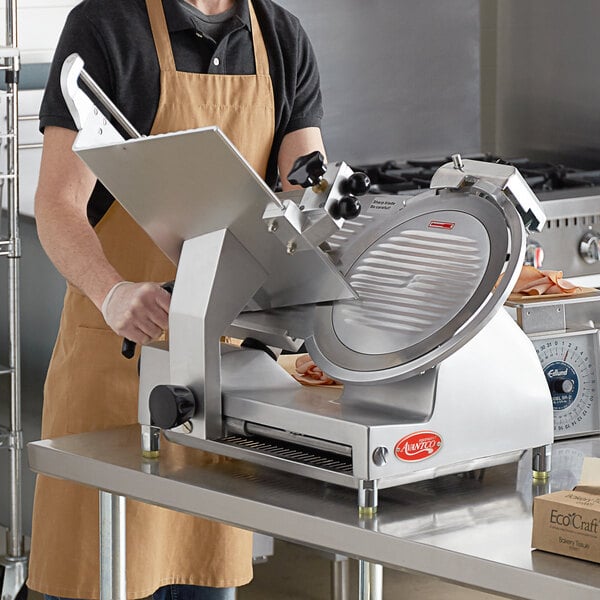
Meat slicer uses vary from slicing meat to slicing cheese and shredding lettuce. You can even use them to cut up cucumbers or other vegetables to save your staff the time of performing classic knife cuts. Whatever you are slicing, be sure to follow the operator's instructions that come with your meat slicer. Also, for safety, always use the provided guide arm to push food. Never use your hands. Make sure any safety features are functioning properly. As a general rule, you can follow these simple steps to safely use a commercial meat slicer.
Wash your hands and put gloves on.
Lift the weighted pusher arm and place the food on the product carriage. Put the pusher and guide back into place to hold the food.
Open the gauge plate to the desired thickness.
Turn the unit on.
Push the carriage back and forth to move the food across the sharp, spinning blade. Check your first slice to ensure it matches the desired thickness and adjust if needed.
Continue pushing the carriage back and forth manually until you have sliced the desired amount of food or, if available, the slicer may be switched to automatic mode to finish the job.
Turn the slicer off and close the gauge plate (turn the blade back to 0) before removing the product.
Wipe down your meat slicer between types of products, and be sure to do a thorough cleaning as needed.
How to Sharpen a Meat Slicer Blade
A meat slicer should be sharpened at least every couple of weeks to keep the blade in optimum shape. Not sure if the blade is sharp enough? You can use a piece of paper to test the sharpness and see if you need to sharpen the blade.
Ensure the slicer is clean before sharpening.
Loosen the bolt on the built-in sharpener.
Turn the sharpener 180 degrees so that it rests over the blade and tighten it down.
Turn the slicer on so that the blade is spinning.
Press and hold the rear sharpening button on the sharpening assembly. Sharpen briefly, no longer than 1 minute at a time, and then release the button.
Press the front finishing button on the sharpener briefly to smooth out the edge and remove any burrs.
Turn off the unit.
Return the sharpening assembly to its original position and tighten it in place.
Additional cleaning may be required to remove any residue from sharpening.
Meat Slicer Cleaning and Maintenance
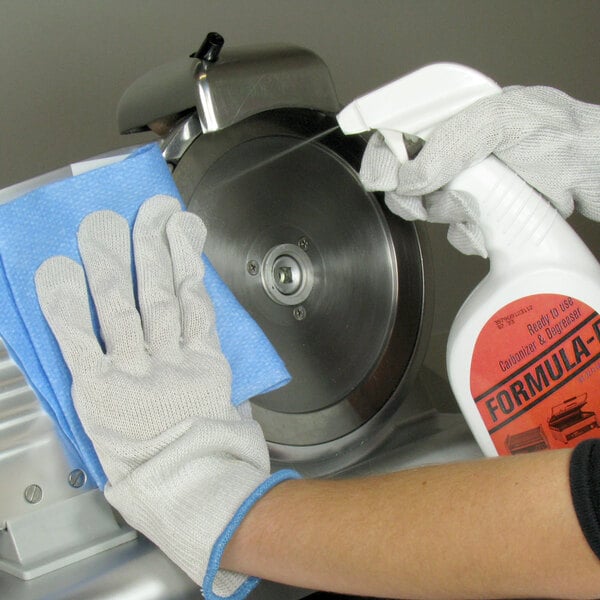
As proper cleaning and sanitizing procedures dictate, you should clean a meat slicer on a regular, daily basis. This can best be accomplished by using a properly mixed commercial sanitizing concentrate and water. Our professional meat slicer safety cleaning kit comes with everything you need to safely clean and sanitize your slicer, including detailed, step-by-step instructions.
It is important to properly lubricate each of the moving parts within the feeder tray, as well as the carriage assemblies. By regularly using a food-grade lubricant, you will ensure that your slicer operates as smoothly as possible and lasts for years to come.
Related Resources

June 2026 WebstaurantStore Coupon Code
Summer is upon us, and to celebrate WebstaurantStore has blazing hot deals all month long! With summer vacations underway and holidays like Independence Day rapidly approaching, now is the time to stock up on essential supplies and equipment you'll need to get through the summer season. Take a look at our wide array of sale items below and don't forget to enter the code SUMMERSALE at checkout to enjoy up to 20% off your purchases! Looking to save even more? Check out the new Webstaurant Rewards® Visa Business Card ! Sign up for a new card today and start earning rewards on every WebstaurantStore purchase, and save on a WebstaurantPlus subscription. Have a look at some incredible deals on disposable items with June's monthly coupon code! Whe

How to Open a Pizza Shop
Pizza shops are one of the most popular types of foodservice establishments in the country. They can be found in countless towns and are often a staple of local culture, with many geographical regions even having types of pizza that are unique to them. Whether you're new to the pizza industry or have worked in it for years, opening a pizzeria can be a great investment. We'll walk you through the steps of starting a pizza shop so that you can position your business for success. Shop All Pizza Shop Supplies and Equipment Click any of the tips below to skip to the pizza shop startup tip that interests you: Write a Pizza Shop Business Plan Choose a Service Style and Brand Create a Menu Identify a Location Secure Funding Buy Pizza Shop Equipment
Commercial Meat Grinder Buying Guide
Commercial meat grinders are designed to efficiently grind and process meat, making them ideal for butcher shops, delis, restaurants, and other commercial kitchens. This equipment comes in a variety of sizes and configurations to suit different production needs. From small countertop models suitable for low-volume operations to large industrial-grade machines capable of processing hundreds of pounds of meat per hour, there is a commercial meat grinder to fit every business's requirements. Discover the different types of meat grinders available for your establishment and the various factors you should consider to find the best commercial meat grinder for your establishment: Shop All Commercial Meat Grinders Use the following links to explore
Join Our Mailing List
Receive coupon codes and more right to your inbox.