- Topics 1577
- Industrial 59
- Troubleshooting Guides 32
- Restaurant Management 144
- Bar Management 70
- Catering Tips 46
- Bakery Management 45
- Food Trucks & Concessions 41
- Advertising & Marketing 41
- Eco-Friendly Tips 13
- Facility Layout & Design 47
- Coffee Shop Tips 32
- Installation & Maintenance 63
- Janitorial & Pest Control 34
- Safety & Sanitation 121
- Startup Tips 111
- Menu Design 11
- Kitchen & Cooking Tips 106
- Hospitality Management 26
- Pizza & Sandwich Shop Tips 23
- Smallwares 42
- Food Prep 102
- Tabletop Items 21
- Disposables 28
- Calculators & Tools 7
- Consumables 77
- Warewashing & Laundry 22
- Cooking Equipment 106
- Food Storage & Refrigeration 58
- Beverage Equipment 43
- Office Supplies 6

Commercial ranges are the heart of any kitchen, providing the power and versatility needed to cook various menu items efficiently. With a variety of options available, choosing the best commercial range for your business can seem like a daunting task. Key factors to consider when choosing a commercial range include the size and layout of your kitchen, the type of cuisine you serve, and the volume of food you need to prepare. We'll break down the various types of commercial stoves available so you can find the perfect range to meet your cooking demands.
Shop All Commercial Stoves and Ranges
Commercial ranges, also commonly referred to as commercial stoves, are essential equipment in any professional kitchen. These versatile appliances are designed to handle various cooking tasks, making them a crucial component for chefs and foodservice establishments. Commercial ranges allow chefs to boil, steam, simmer, fry, grill, and saute foods, providing the flexibility needed to prepare diverse menus efficiently.
One of the key features of commercial ranges is their ability to offer different cooking options in a single unit. Most commercial stoves come with ovens, allowing chefs to bake, roast, and broil dishes alongside stovetop cooking. Certain models may also include griddle tops, providing a flat cooking surface ideal for preparing pancakes, eggs, and burgers.
Watch our video to learn more about commercial ranges and the configurations out there.
When selecting a commercial range for your foodservice establishment, it's essential to consider the specific needs of your kitchen to ensure optimal efficiency and productivity. Beyond the classic range styles, various specialty ranges are available, each designed to cater to different cooking requirements. Based on your menu, kitchen size, and daily volume, you may find that your operation will benefit from having more than one range type.
Restaurant Range
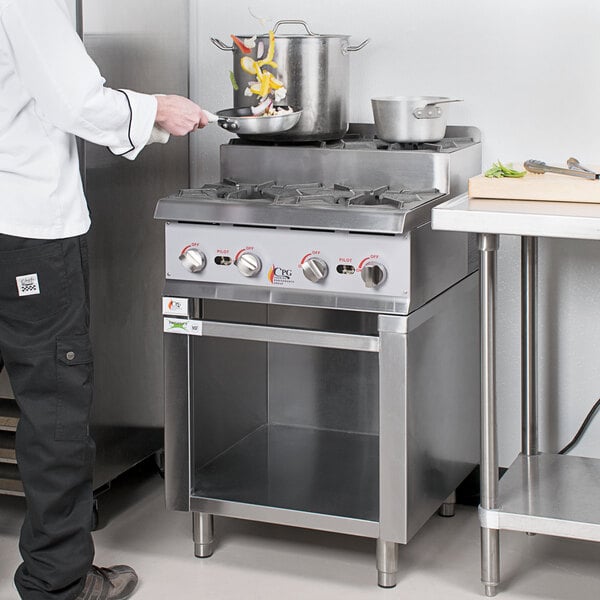
Restaurant ranges, also known as medium-duty ranges, are standalone units that offer a cost-effective solution for commercial kitchens. These ranges typically have a gas connection in the back, making them easier to install in various kitchen layouts.
While these ranges have a lighter-duty construction than heavy-duty ranges, they are still designed to withstand the demands of a busy kitchen environment. The burners provide plenty of BTUs for most cooking tasks but will take longer to heat and cook foods than a heavy-duty range. They are also more affordable with upfront and energy costs.
- Power Type: Gas
- Number of Burners: 4 - 6
- Best For: Most commercial kitchens, food stands, and churches
Heavy-Duty Ranges
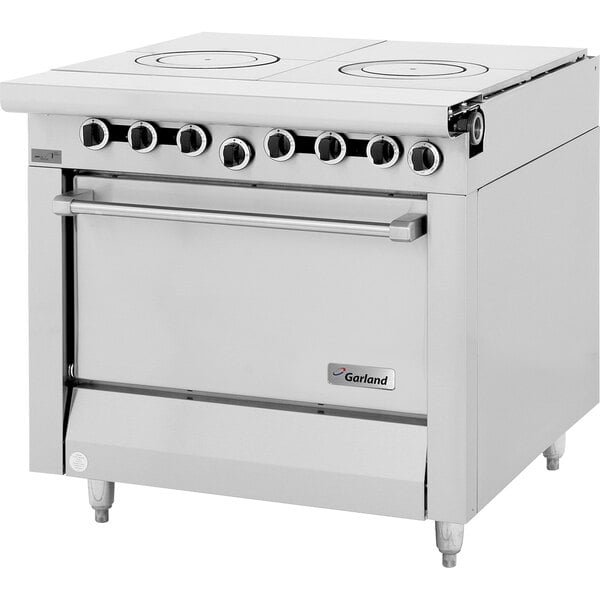
Heavy-duty ranges are designed for high-volume cooking operations that will be using their range virtually all day to serve a large number of people. These ranges operate with higher burner and oven BTU ratings, offering faster cooking times and increased efficiency. They come with several top configurations and burner options to suit different cooking needs. While heavy-duty ranges may come at a higher price point compared to restaurant ranges, their advanced features and robust construction make them a worthwhile investment for high-volume kitchens.
Heavy-duty ranges are constructed with thicker gauges of metal and more welded components, ensuring long-term durability in demanding kitchen environments. They can be used as standalone units but are typically designed to be banked together "in battery" with other ranges or pieces of equipment, allowing for a customized cooking setup. The gas connection is often located on the side or rear, providing flexibility for various kitchen configurations.
- Power Type: Gas
- Number of Burners: 1 - 12
- Best For: Cafeterias, hospitals, and high-volume restaurants
Countertop Gas Range
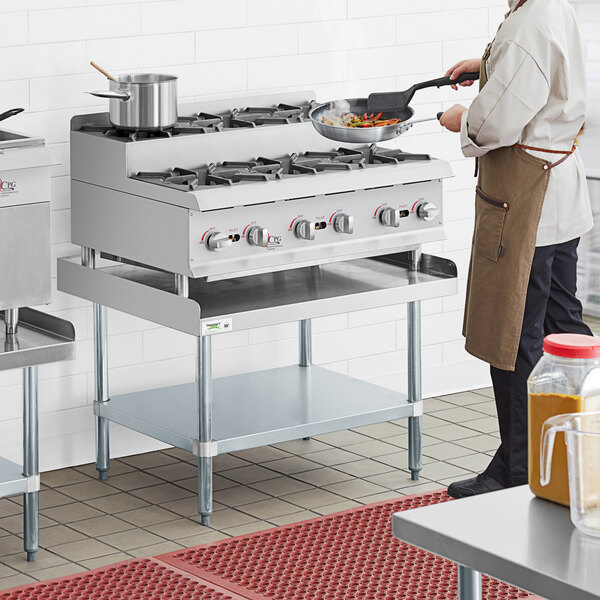
Countertop gas ranges are compact and versatile cooking appliances that can be placed on existing countertops or work surfaces. They are perfect for small kitchens, food trucks, or establishments with limited space.
Countertop gas ranges come in standard-duty and heavy-duty models, catering to different levels of cooking intensity. Some gas models feature a step-up design that provides extra cooking space, allowing more dishes to be prepared simultaneously. Many are field-convertible, allowing operators to use natural gas or liquid propane.
- Power Type: Gas
- Number of Burners: 1 - 10
- Best For: Food stands, food trucks, and kiosks
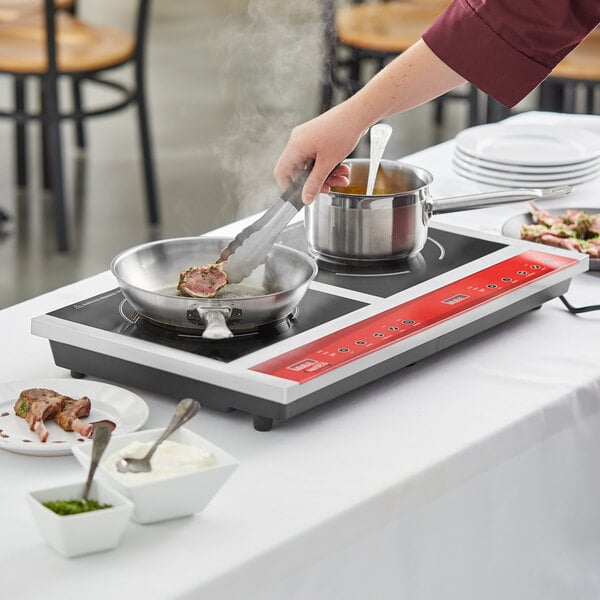
Induction Countertop Range
Induction countertop ranges offer a modern and efficient cooking solution. Some induction models can be used as a drop-in or countertop unit, offering installation flexibility. Portable and lightweight, they are ideal for front-of-the-house operations and display cooking like catered events, breakfast bars, or buffets.
An induction cooker is safer than a gas countertop range since there's no open flame. This means less ambient heat in your kitchen and most importantly no open flame or flammable fuels that could be a potential safety hazard. Many models have built-in safety features like an automatic standby mode once cookware is removed. Induction technology also ensures rapid heating and precise temperature control, allowing chefs to adjust heat levels quickly and accurately and reduce cooking times.
- Power Type: Electric
- Number of Burners: 1 - 4
- Best For: Catering companies, offsite cooking events, and hotels
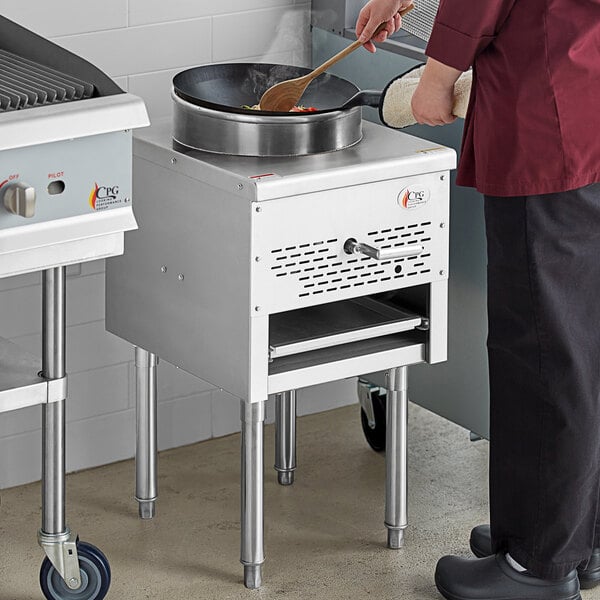
Wok Range
A wok range is designed for high-heat cooking techniques such as stir-frying, searing, and sauteing. It features high-BTU burners that heat up quickly and a raised ring that supports round-bottomed woks, allowing for fast and efficient cooking.
Restaurants that specialize in Asian cuisine or dishes that require intense heat will benefit from having a wok range in their kitchen. They are a great fit if you have limited kitchen space with a menu heavily dependent on sauteing veggies and meat.
- Power Type: Gas
- Number of Burners: 1 - 4
- Best For: Japanese steakhouse, Asian restaurant, or catering company
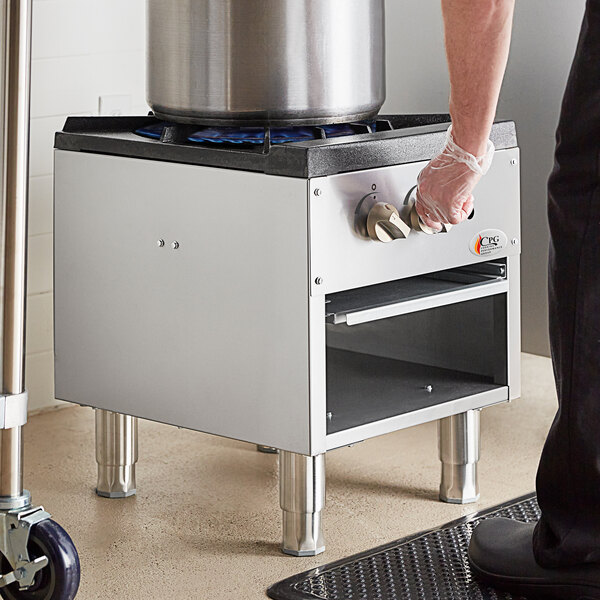
Stock Pot Range
As the name suggests, stock pot ranges are specifically designed to heat large stock pots full of soups, stews, stocks, and sauces. Catering companies, cafeterias, and restaurants frequently cooking in bulk will find a stock pot range indispensable.
These ranges typically feature multiple burners or a single large burner with a high BTU output to accommodate the size and weight of stock pots. They are relatively compact units, featuring a low height that reduces the risk of spills and makes it easier to lift large and heavy pots. This helps improve worker comfort and safety in a crowded kitchen.
- Power Type: Gas
- Number of Burners: 1 - 4
- Best For: Catering companies, banquet halls, and cafeterias
Commercial ranges are available in gas and electric models. Each energy source has its own set of benefits and drawbacks. Consider factors such as cooking style, energy costs, safety considerations, and local regulations to determine which energy source is the best fit for your kitchen.
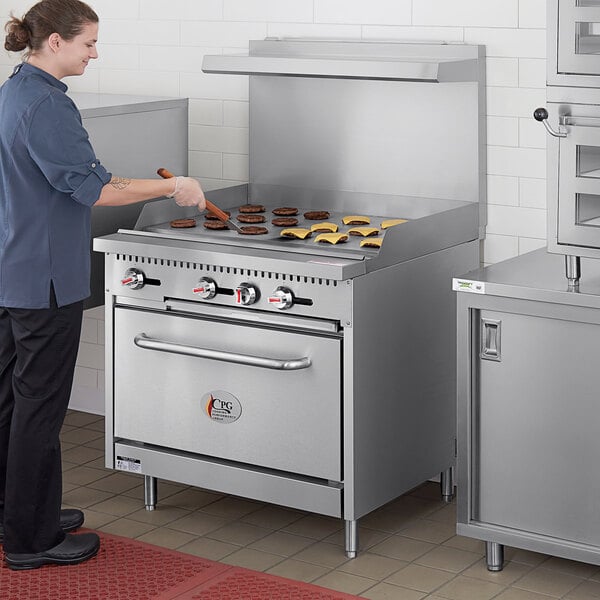
Commercial Gas Range
Commercial gas ranges are the most popular option, favored by many chefs and cooks for their precise control over heat levels. The open flame allows for quick adjustments and even heat distribution, making them ideal for cooking techniques that require rapid temperature changes. Gas ranges require a gas connection and professional installation, which can increase your upfront costs.
- Precise temperature control and fast heat-up times
- More cost-effective option
- Ideal for high-volume kitchens that rely heavily on their range
- Produce a lot of ambient heat in your kitchen
Commercial Electric Range
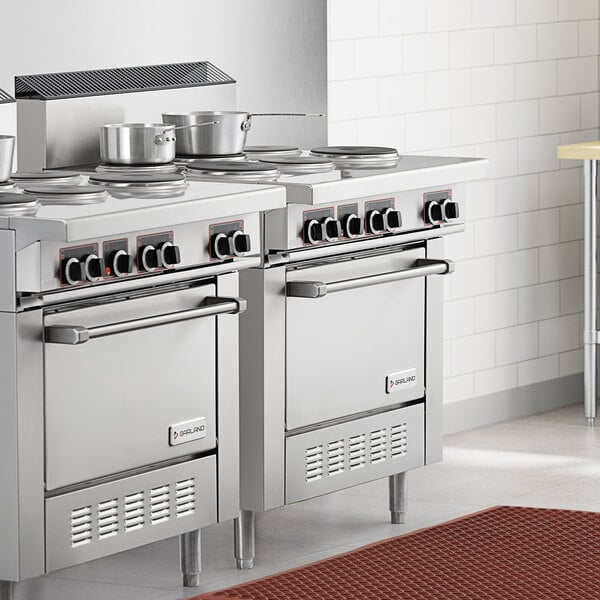
While they are more expensive to purchase upfront, commercial electric ranges are valued for their energy efficiency, ease of maintenance, and safety. Their biggest drawback is that they do not heat up as quickly as gas models, making them better suited for lower-volume kitchens.
- More energy efficient
- Produce less ambient heat in the kitchen
- Stove surface is easy to clean
- Less precise temperature control
- Do not heat up as quickly
The most common sizes of ranges are 24", 48", and 60" wide, but models are available anywhere from 12" up to 72" - typically in increments of 12" or 18". Restaurant ranges often measure between 24" and 72", while heavy-duty, modular versions will measure between 32" and 36" per section.
When determining the best range width for your kitchen, keep the following things in mind:
Hood Space
Most health/safety codes require the hood to extend at least 6" beyond each piece of equipment you put under it. For example, if you have a 48" wide hood, the widest range you could put underneath it would be a 36" model. It's always best to check with your local regulators to be sure.
Menu and Application
If you're only serving breakfast, do you need open burners, or would you be better off with a griddle or griddle top? For example, if you serve a wider variety of food or different meals, think about how much burner versus griddle space you might need.
- Most range manufacturers offer griddle options in 12" wide increments, so you can tailor the exact configuration of griddle space versus burners to match your cooking needs.
- Some sizes, such as 24" and 48" typically feature "space saver" ovens.
Consider the type of cooking you will be doing in your kitchen when selecting the top configuration for your commercial range. Each option offers unique benefits and caters to different cooking styles and menu items. Choose a range top configuration that aligns with your menu requirements and kitchen workflow to maximize the efficiency and performance of your commercial range.
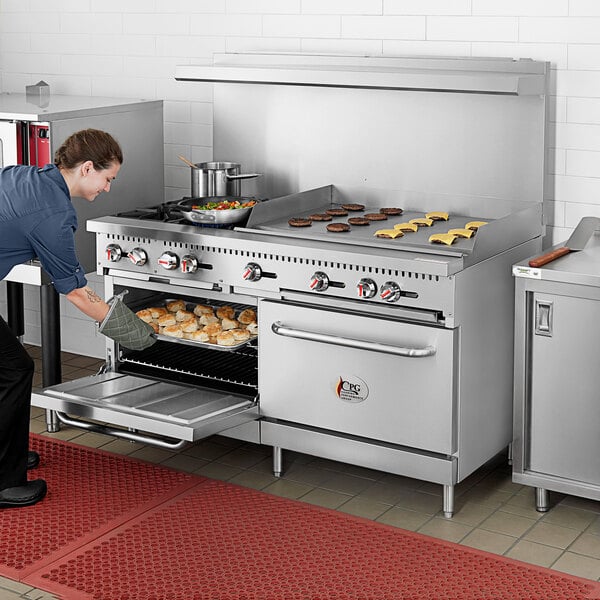
- Open Burner: Open burners are the most common and versatile stovetop configuration. They produce an open flame to provide direct, controlled heat and feature cast iron or stainless steel grates to hold the pot or pan over the burner.
- Griddle Top: Ranges equipped with a griddle top offer a flat cooking surface that is perfect for preparing foods like pancakes, eggs, burgers, and grilled sandwiches. Griddles provide consistent heat distribution and are excellent for achieving even cooking results. They are a popular choice in breakfast and brunch establishments.
- Hot Top: A hot top is a smooth even cooking surface that covers the whole range top. It may look a little bit like a griddle or flat top, but its not meant for direct food contact. Instead, this flat surface provides more flexibility for pans of different sizes and shapes. You can take advantage of every square inch of the hot top and even create side-by-side zones of greater or lesser heat.
- French Top: A French top is a flat cooking surface similar to a hot top, but it has concentric circles in the middle which indicate different heat zones. The middle of the cook top is the hottest zone and as you move outward away from the circle's center, the zones become cooler. This allows you to slide pans around the cook top to apply the level of heat that you need.
- French Plate: Not to be confused with a French top, a French plate is a round metal plate that covers a single burner on an electric range. The flat plate helps to provide better heat distribution across the burner and promotes easier cleaning.
- Plancha: A plancha top is designed for direct food contact and looks very similar in appearance to a griddle. The center of the plate is hotter than the perimeter, allowing you to sear in the middle and finish/hold food on the edges at a lower temperature.
If you're going with a restaurant or heavy-duty range, the model will likely include more than just the burners. Ranges will frequently come in tandem with ovens, storage cabinets, and other base types that expand their versatility. With so many options available, it'll be up to you to determine what best fits your menu.
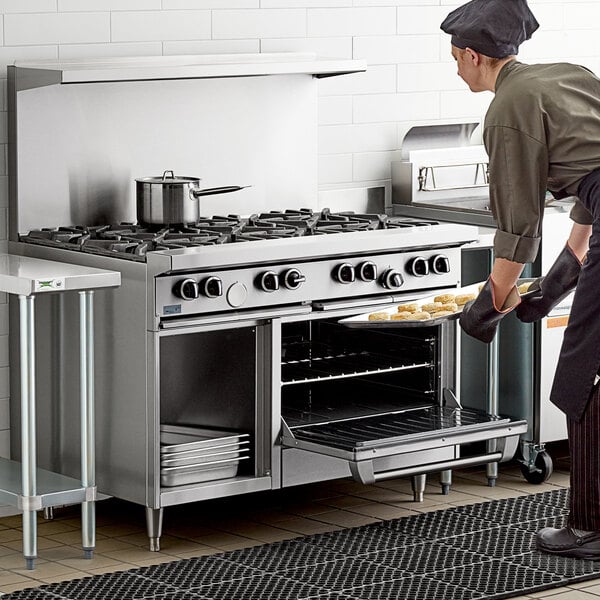
- Standard Oven: The most popular option, standard ovens are at least 26" wide and will hold full size sheet pans in either direction.
- Convection Oven: These ovens utilize interior fans to move the hot air around the cavity and cook food faster and more evenly. These models are more expensive than standard ovens.
- Space-Saver Oven: Ideal for small kitchens, space-saving ovens are approximately 20" wide by 26" deep and can accommodate full size sheet pans lengthwise.
- Storage Base: These are simply an open cavity beneath the range top, in place of an oven, and provide space to hold pots, pans, and other kitchen tools close at hand. Storage bases can range in size from 12" to 36", and they can take up the entirety of the base or share space with an oven or refrigerator.
- Refrigerated Chef Base: A refrigerated chef base keeps cold ingredients nearby and ready to grab at a moment's notice.
By evaluating your kitchen's layout, menu offerings, and cooking volume, you can narrow down your options and select the best commercial range for your business needs. If you're still having trouble deciding which restaurant range to purchase, check out our commercial range reviews to compare the best options out there!
Related Resources

June 2026 WebstaurantStore Coupon Code
Summer is upon us, and to celebrate WebstaurantStore has blazing hot deals all month long! With summer vacations underway and holidays like Independence Day rapidly approaching, now is the time to stock up on essential supplies and equipment you'll need to get through the summer season. Take a look at our wide array of sale items below and don't forget to enter the code SUMMERSALE at checkout to enjoy up to 20% off your purchases! Looking to save even more? Check out the new Webstaurant Rewards® Visa Business Card ! Sign up for a new card today and start earning rewards on every WebstaurantStore purchase, and save on a WebstaurantPlus subscription. Have a look at some incredible deals on disposable items with June's monthly coupon code! Whe
Is Gas or Electric Better for Restaurants?
Whether you're buying equipment for your new restaurant or replacing worn-out equipment, every operator must make the crucial decision between investing in a gas or electric range. Consider factors such as heat control, heat distribution, and the types of dishes you typically prepare when deciding which type of range is best suited for your commercial kitchen. We walk you through the key considerations of choosing between each heat source and explain how both units work so you can make an informed purchasing decision. Shop All Commercial Ranges Learn more about gas and electric cooking: Gas vs Electric Range What Is a Gas Range? What Is an Electric Range? How to Switch from Gas to Electric Stove How to Switch from Electric to Gas Stove Gas
Types of Commercial Kitchen Hoods
Finding the right commercial vent hood for your kitchen is essential for maintaining air quality, keeping the room temperature at a comfortable level, and preventing fire hazards. The type of hood your restaurant needs depends on the equipment your kitchen uses, the foods on your menu, and the space available to you, as well as local commercial kitchen hood requirements . In this guide, we'll cover the different range hood types and restaurant hood systems used in commercial settings, as well as fire suppression systems, to ensure you outfit your kitchen with the correct ventilation. Shop All Commercial Kitchen Hoods Skip ahead to learn more about kitchen hoods: Type 1 vs. Type 2 Hood Systems Different Types of Kitchen Hoods Kitchen Hood In
Join Our Mailing List
Receive coupon codes and more right to your inbox.